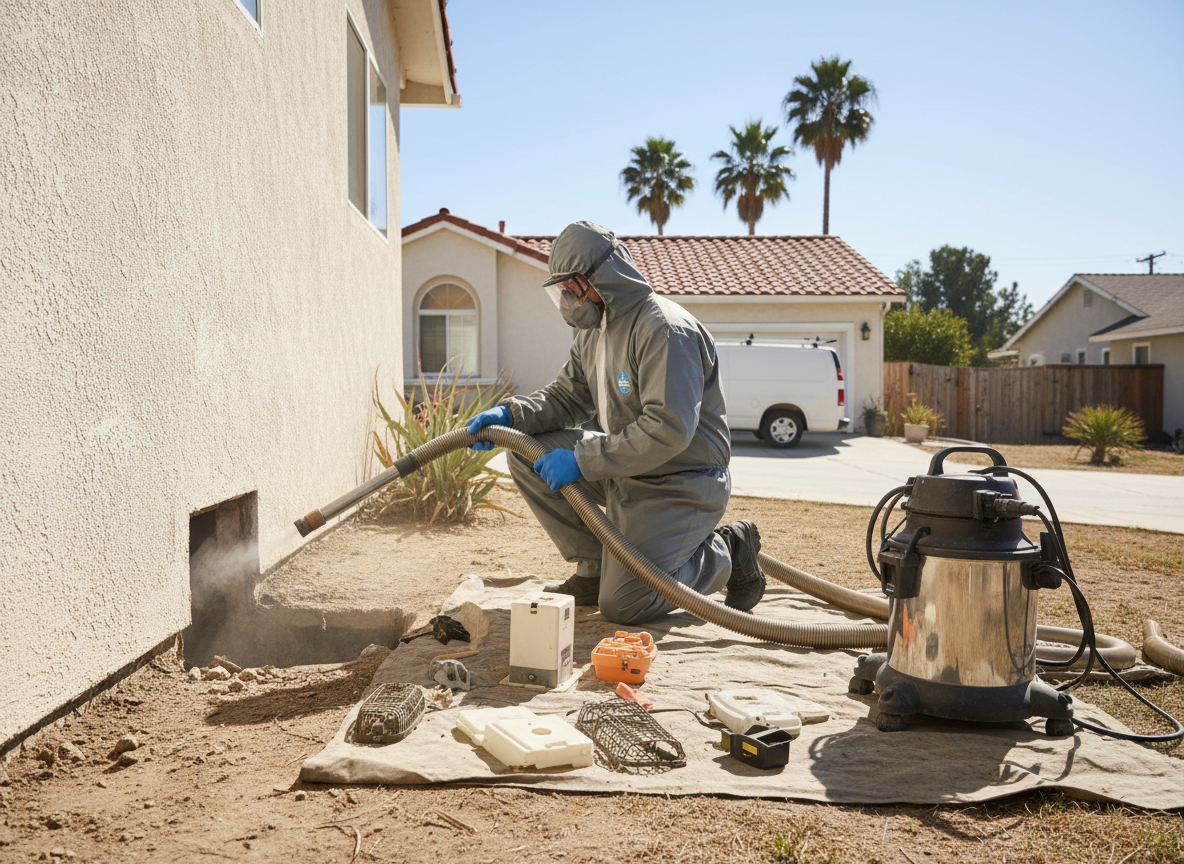
A rodent exterminator does more than set traps. Structural rodent work in California requires a Structural Pest Control Board license, Branch 2, which covers wood-destroying and structural pest work, and any pesticide application must follow California Department of Pesticide Regulation labeling. That licensing matters because rodent extermination touches the building envelope, attic insulation, crawl space framing and, in commercial settings, food safety documentation. A rat exterminator working on a structure is making decisions about construction as much as about pest biology.
Extermination method depends entirely on which species is present. Roof rats (Rattus rattus) enter high along the roofline from tree limbs, palm fronds and utility lines, and nest in attics, soffits and wall voids. Norway rats (Rattus norvegicus) enter low through crawl space vents, foundation gaps, floor drains and sewer laterals, and burrow against slabs. House mice (Mus musculus) pass through a quarter-inch gap, breed year-round and colonize cabinetry, appliance housings and insulation. A mice exterminator seals to a tighter tolerance than a rat exterminator, and places far more devices over a smaller area, because mouse home ranges are measured in feet rather than yards.
Rodent Exterminator Near You — Choose Your City
Every city below has its own local Rodent Exterminator page with coverage details.
Orange County
Los Angeles County
Los Angeles
Alameda County
Riverside County
San Bernardino County
San Diego County
Contra Costa County
Santa Clara County
Fresno County
San Diego
Ventura County
Solano
San Francisco
Sacramento
Kern County
San Joaquin
Stanislaus County
San Bernardino
Ventura
Sonoma
Sacramento County
Monterey
Placer County
Tulare County
Riverside
San Mateo
California law has changed what a legitimate exterminator can use. AB 1788, the California Ecosystems Protection Act, placed a statewide moratorium on most uses of second-generation anticoagulant rodenticides including brodifacoum, bromadiolone, difethialone and difenacoum, after documented secondary poisoning in owls, hawks, bobcats and mountain lions. Any exterminator still pitching a bait-heavy residential program is either working outside current restrictions or setting the customer up for a dead rodent inside a wall void. Compliant extermination is built on Integrated Pest Management: inspection, species identification, mechanical trapping, sanitation correction and physical exclusion.
Trapping placement is where experienced technicians separate from inexperienced ones. Rats show neophobia, meaning they avoid new objects in open space for several days. Traps are therefore set flush against walls, beams and rafters on confirmed runways, identified by greasy rub marks, droppings, gnaw marks and tracks in dust or insulation, with the trigger oriented toward the wall. Devices are checked on a set schedule and repositioned as activity shifts. Enclosed and multi-catch devices are used where children, pets or non-target wildlife are present. Glue boards are avoided because they cause prolonged suffering and capture non-target animals.
Extermination is only permanent when exclusion follows. Every gap wider than a quarter inch is sealed with quarter-inch hardware cloth, sheet metal, copper mesh, mortar and door sweeps. The recurring failure points across California housing stock are roof-to-fascia gaps on tile and shake roofs, unscreened attic and foundation vents, dryer and bath exhaust terminations, plumbing and electrical penetrations, garage door bottoms and crawl space access panels. Pre-1950 construction with wood siding, shallow foundations and open utility chases needs substantially more sealing labor than newer slab-on-grade builds. After sealing, droppings and contaminated insulation are removed with disinfection rather than dry sweeping, since rodent waste can carry hantavirus, leptospirosis, salmonellosis and rat-bite fever.
Technician insight
If an exterminator quotes you a rodent job over the phone without inspecting, walk away. There is no way to price rat extermination without knowing the species, the entry point count and whether the attic and crawl space are accessible, and those three variables move the number by a factor of five. The second thing worth knowing is that an exterminator whose plan is mostly bait is behind the law. AB 1788 took most second-generation anticoagulants off the table in California, and bait was always the weaker option structurally, because the rodent dies in the wall and you inherit a dead rodent removal job plus six weeks of odor. The exterminators who get durable results are the ones who spend most of the labor hours on the ladder sealing the building, not on the traps.
Second exterminator on a repeat roof rat job
A homeowner had used another company twice in eight months. Both visits were bait station refills with no inspection of the roofline. Activity always returned within six weeks. Our inspection found three open entry points that had never been touched: an unscreened attic gable vent, a gap where a satellite cable entered the fascia, and a roughly two-inch opening at the junction of the garage roof and the main roof deck. Rub marks on the rafters showed a well-established runway. Snap traps were set flush along that runway, catching four roof rats over nine days. All three entry points were then sealed with quarter-inch hardware cloth and sheet metal, and about sixty square feet of urine-contaminated insulation was removed and replaced. The verification visit at two weeks found no new droppings, and the follow-up at three months found none either.
Rodent Exterminator Services We Offer
✓Rat Exterminator Service
Roof rat and Norway rat extermination using runway trapping in attics, wall voids and crawl spaces, followed by roofline and foundation exclusion sealing.
✓Mice Exterminator Service
House mouse extermination in kitchens, pantries, wall cavities and appliance voids, with the tighter quarter-inch exclusion tolerance mouse work requires.
✓Attic and Roofline Extermination
Trapping along rafter and joist runways, contaminated insulation removal, and screening of vents, eaves and roof-to-fascia gaps.
✓Crawl Space and Foundation Work
Norway rat burrow treatment, subfloor trapping, vapor barrier and duct damage assessment, and hardware cloth vent screening.
✓Commercial Extermination Programs
Integrated Pest Management programs for restaurants, warehouses and multi-tenant buildings with numbered device maps and service documentation for health inspections.
✓Exclusion and Rodent Proofing
Permanent sealing of every gap wider than a quarter inch using hardware cloth, sheet metal, copper mesh and door sweeps, the step that ends re-infestation.
Rodent Exterminator Cost in California
| Service | Typical Range | What Affects It |
|---|---|---|
| Inspection and species identification | $125-$275 | Higher where attic or crawl space access is restricted or the property is multi-story |
| Mice exterminator program | $200-$500 | House mice breed continuously, so programs usually span more return visits than rat work |
| Rat exterminator program | $300-$700 | Roof rat and Norway rat extermination, priced by infestation level and property size |
| Exclusion and rodent proofing | $400-$1,400 | Driven by entry point count, roof access and whether the home is pre-1950 construction |
| Commercial IPM program | $150-$450 per visit | Based on device count, service frequency and audit documentation requirements |
Ranges are typical for California and confirmed with an exact written quote before any work starts.
How it works
- 1
Licensed Inspection and Species Identification
A licensed technician inspects the attic, crawl space, garage, roofline and exterior perimeter, confirming whether the property has roof rats, Norway rats or house mice from droppings, rub marks, burrows and gnaw patterns. Every entry point is mapped.
- 2
Integrated Pest Management Plan
A written plan sets device type, placement and check frequency, plus the sanitation and structural corrections required. Method selection complies with AB 1788 and CDPR labeling rather than defaulting to rodenticide.
- 3
Runway Trapping
Snap traps and enclosed devices are set flush against walls, beams and rafters on confirmed travel paths, with triggers facing the wall. Devices are checked on schedule and repositioned as activity shifts.
- 4
Exclusion Sealing
Once activity drops, gaps wider than a quarter inch are sealed with quarter-inch hardware cloth, sheet metal, copper mesh and mortar. Vents are screened, door sweeps fitted and roof-to-fascia gaps closed.
- 5
Sanitation and Decontamination
Droppings, nesting material and urine-contaminated insulation are removed after pre-misting with disinfectant. Dry sweeping is avoided because it aerosolizes pathogens.
- 6
Verification and Warranty Check
A return visit one to two weeks later confirms no fresh droppings, gnaw marks or runway activity, and every seal is re-inspected.
Pricing
Extermination cost is set by species, infestation level, structure size and the amount of exclusion required. Written quote after inspection, Mon-Fri 8am-6pm and Sat 9am-2pm.