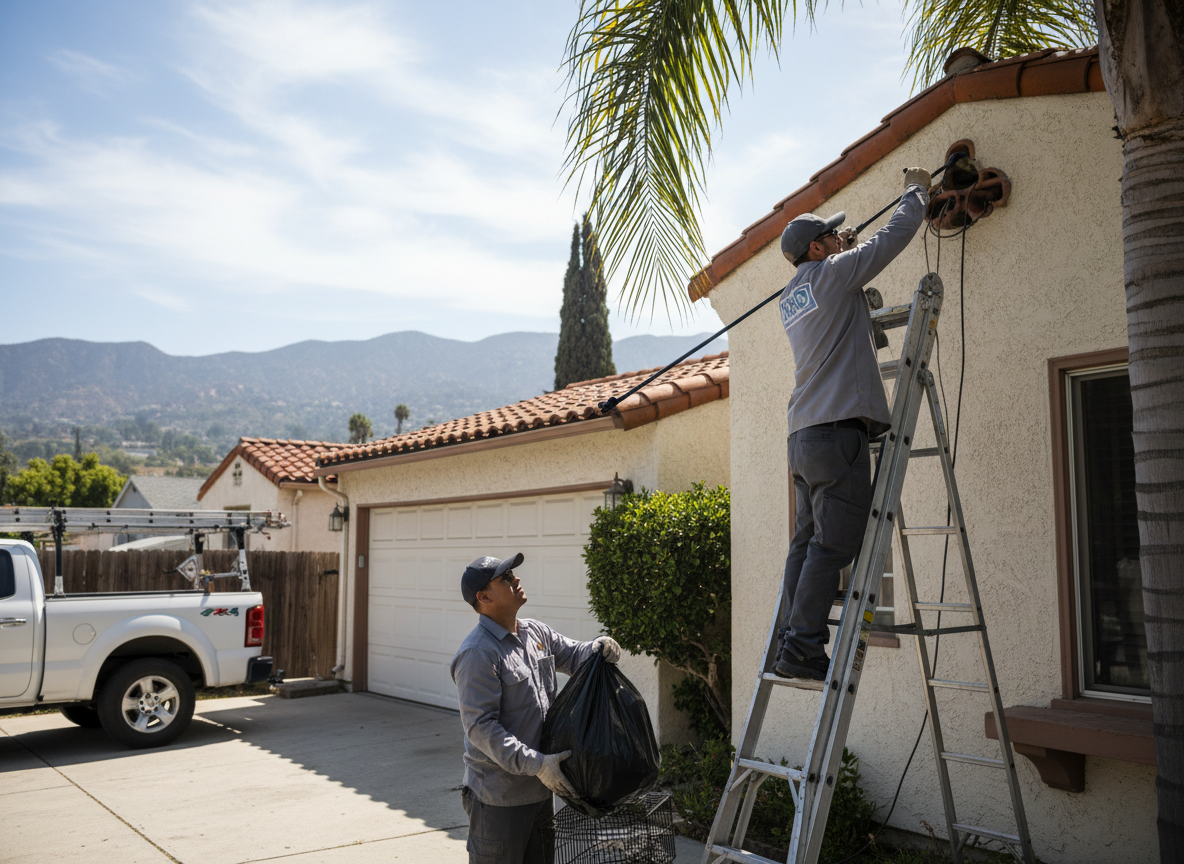
Rodent removal is the process of getting the live animals out of a structure and keeping them out. It covers rat removal, mice removal and the exclusion work that follows. The three species found in California buildings behave differently enough that removal strategy changes completely between them. Roof rats (Rattus rattus) climb and enter high, nesting in attics, wall voids and dropped ceilings. Norway rats (Rattus norvegicus) burrow and enter low, through crawl space vents, foundation gaps and floor drains. House mice (Mus musculus) fit through a quarter-inch gap, breed continuously, and nest in cabinetry, insulation and appliance housings. Removal that assumes the wrong species puts traps in the wrong places.
Species identification happens during the inspection using droppings, runways and physical evidence. Mouse droppings run 1/8 to 1/4 inch with pointed ends and appear in scattered numbers near food. Rat droppings run 1/2 to 3/4 inch with blunter ends and cluster along defined travel paths. Rats leave greasy rub marks where fur repeatedly contacts framing, plus visible runways in dust and insulation. Norway rats leave burrow openings two to four inches across near foundations and under slabs. Roof rats leave droppings and gnaw damage in attics, along rafters and around roof penetrations.
Trapping is placement-driven, not volume-driven. Devices go on confirmed runways against walls, beams and rafters where rodents already travel, because rats in particular follow consistent paths and show neophobia toward new objects in open space. Snap traps are the primary tool for both rat removal and mice removal. Enclosed and multi-catch devices are used where children, pets or non-target wildlife are a concern. Devices are checked on a set schedule and repositioned as activity shifts rather than left unattended.
California's rodenticide rules matter here. AB 1788, the California Ecosystems Protection Act, placed a statewide moratorium on most uses of second-generation anticoagulant rodenticides including brodifacoum, bromadiolone, difethialone and difenacoum, following documented secondary poisoning in owls, hawks, bobcats and mountain lions. Bait-led removal also has a practical failure mode: a poisoned rodent frequently dies inside a wall void or under a subfloor, producing weeks of decomposition odor and a secondary removal job. Trapping recovers the carcass. Any product use follows California Department of Pesticide Regulation labeling and requires a Structural Pest Control Board license, Branch 2.
Removal is not finished when the trapping stops. Exclusion seals every gap wider than a quarter inch using 1/4 inch hardware cloth, sheet metal, copper mesh, mortar and door sweeps. Vents, roof-to-fascia gaps, plumbing and electrical penetrations, dryer and bath exhausts, garage door bottoms and crawl space access panels are the recurring failure points. After sealing, droppings, urine-contaminated insulation and nesting material are removed with disinfection rather than dry sweeping, because rodent waste can carry hantavirus, leptospirosis, salmonellosis and rat-bite fever. A verification visit one to two weeks later confirms the structure is clear.
Technician insight
The single biggest reason rodent removal fails is that people stop at the trapping. Traps clear the animals currently inside. If the quarter-inch gap at the fascia line or the unscreened crawl space vent stays open, a new group is in within weeks, because California has no winter that shuts rodent activity down. The second most common failure is bait-led removal, where the rodent dies inside a wall void. Now you have a dead rodent removal job on top of the original problem, plus four to six weeks of odor and a flush of blow flies. Trapping recovers the carcass, which is exactly why it remains the standard for structural removal.
Mice removal in a kitchen that kept coming back
A homeowner had been setting their own snap traps for three months, catching mice steadily and never getting ahead. The inspection found the traps were placed in the middle of the pantry floor rather than against the wall, where mice actually travel. More importantly it found the source: a gap around the gas line penetration behind the range, roughly half an inch, plus an unsealed opening under the dishwasher where the supply line entered from the crawl space. Traps were repositioned flush against the wall runways with the trigger facing the wall. Both penetrations were packed with copper mesh and sealed. Crawl space vents were screened with 1/4 inch hardware cloth. Catches stopped after nine days and the two-week verification visit found no fresh droppings.
Rodent Removal Services We Offer
✓Rat Removal
Removal of roof rats and Norway rats from attics, walls, crawl spaces and commercial voids using runway trapping, followed by roofline and foundation exclusion.
✓Mice Removal
House mouse removal from kitchens, pantries, wall cavities and appliance housings, with the tighter quarter-inch exclusion that mouse control requires.
✓Attic Rodent Removal
Extraction of nesting rodents from attic insulation and rafters, plus contaminated insulation removal, disinfection and roof vent screening.
✓Crawl Space and Subfloor Removal
Norway rat burrow work under floors, including vapor barrier and duct damage assessment and hardware cloth vent screening.
✓Wall Void Rodent Extraction
Locating and removing rodents nesting inside wall cavities, including access, removal and repair of the opening.
✓Dead Rodent Location and Removal
Tracing decomposition odor to inaccessible voids, extracting the carcass and treating the area for residual odor and ectoparasites.
Rodent Removal Cost in California
| Service | Typical Range | What Affects It |
|---|---|---|
| Inspection and species identification | $125-$275 | Higher where attic or crawl space access is restricted |
| Mice removal program | $200-$500 | House mice breed quickly, so removal usually spans more return visits than rats |
| Rat removal program | $250-$650 | Roof rat and Norway rat removal, based on infestation level and property size |
| Exclusion sealing | $400-$1,400 | Driven by entry point count and roof or crawl space access difficulty |
| Decontamination and cleanup | $450-$1,500 | Droppings removal, disinfection and contaminated insulation, priced by area |
Ranges are typical for California and confirmed with an exact written quote before any work starts.
How it works
- 1
Inspection and Species Identification
Attic, crawl space, garage, roofline and exterior perimeter inspected. Species confirmed from droppings, runways, rub marks and burrows. Every entry point mapped and photographed.
- 2
Targeted Trapping
Snap traps and enclosed devices set on confirmed runways rather than scattered. Checked on a set schedule and repositioned as the activity pattern changes.
- 3
Removal and Carcass Recovery
Captured rodents removed on each service visit. Trapping is preferred over baiting specifically so carcasses are recovered rather than left to decompose inside voids.
- 4
Exclusion Sealing
Gaps wider than a quarter inch sealed with 1/4 inch hardware cloth, sheet metal, copper mesh and door sweeps. Vents screened, roof and foundation penetrations closed.
- 5
Decontamination
Droppings, nesting material and urine-contaminated insulation removed with disinfection. Dry sweeping avoided because it aerosolizes pathogens.
- 6
Verification Visit
Return inspection one to two weeks later confirms no new droppings, gnaw marks or runway activity, and every seal is re-checked.
Pricing
Cost depends on species, infestation level, structure size and how much exclusion is required. Written quote after inspection, Mon-Fri 8am-6pm and Sat 9am-2pm.