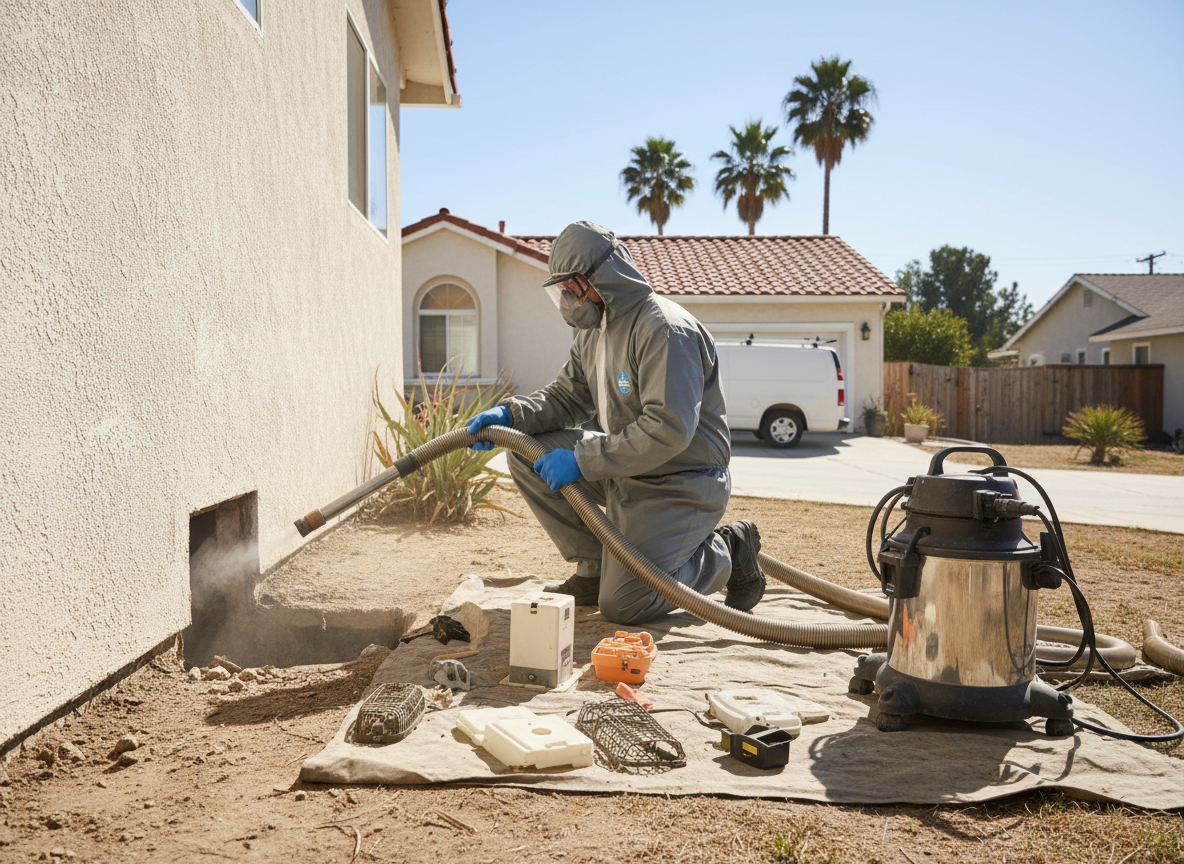
A rodent exterminator working on a Santa Clarita structure needs a California Structural Pest Control Board license, Branch 2, and any pesticide application must follow California Department of Pesticide Regulation labeling. That matters because extermination here is substantially roof work: sealing roof-to-fascia gaps, fitting bird stop closures into tile eave courses, screening gable and soffit vents and capping chimneys. Ask for the license number before work starts, and be cautious of operators offering rodent proofing without one.
The program is a roof program in most Santa Clarita cases, because roof rats dominate and because slab-on-grade construction removes the crawl space alternative. Trapping goes on rafter and top plate runways where rub marks and droppings confirm travel, with devices set flush against the framing and the trigger facing the wood, since rats exhibit neophobia and route around unfamiliar objects placed in open space. Sealing follows once activity stops, then decontamination. Sealing first would trap rodents in the attic and turn the job into a dead rodent removal.
AB 1788 carries particular weight here. The California Ecosystems Protection Act placed a statewide moratorium on most uses of second-generation anticoagulant rodenticides including brodifacoum, bromadiolone, difethialone and difenacoum, and the reason was documented secondary poisoning in owls, hawks, bobcats and mountain lions. Santa Clarita's open space margin is precisely the habitat where those predators live, so a bait-heavy program here is working against both the regulation and the local ecology. On a competent quote most of the labor hours sit on the ladder doing the sealing, not on the traps.
Rodent Exterminator in Santa Clarita — What We Handle
- ✓California Structural Pest Control Board license, Branch 2, is the credential to ask for before any Santa Clarita rodent work begins
- ✓Roof rat programs here are roof programs: fascia gaps, tile end courses, vent screening and tree clearance
- ✓AB 1788 compliance matters more on a wildland interface, where raptors, bobcats and other predators are present
- ✓No phone quotes, because entry point count, roof pitch and tile type move the number substantially
A rodent exterminator does more than set traps. Structural rodent work in California requires a Structural Pest Control Board license, Branch 2, which covers wood-destroying and structural pest work, and any pesticide application must follow California Department of Pesticide Regulation labeling. That licensing matters because rodent extermination touches the building envelope, attic insulation, crawl space framing and, in commercial settings, food safety documentation. A rat exterminator working on a structure is making decisions about construction as much as about pest biology.
Extermination method depends entirely on which species is present. Roof rats (Rattus rattus) enter high along the roofline from tree limbs, palm fronds and utility lines, and nest in attics, soffits and wall voids. Norway rats (Rattus norvegicus) enter low through crawl space vents, foundation gaps, floor drains and sewer laterals, and burrow against slabs. House mice (Mus musculus) pass through a quarter-inch gap, breed year-round and colonize cabinetry, appliance housings and insulation. A mice exterminator seals to a tighter tolerance than a rat exterminator, and places far more devices over a smaller area, because mouse home ranges are measured in feet rather than yards.
How It Works in Santa Clarita
- 1
Licensed Inspection and Species Identification
A licensed technician inspects the attic, crawl space, garage, roofline and exterior perimeter, confirming whether the property has roof rats, Norway rats or house mice from droppings, rub marks, burrows and gnaw patterns. Every entry point is mapped.
- 2
Integrated Pest Management Plan
A written plan sets device type, placement and check frequency, plus the sanitation and structural corrections required. Method selection complies with AB 1788 and CDPR labeling rather than defaulting to rodenticide.
- 3
Runway Trapping
Snap traps and enclosed devices are set flush against walls, beams and rafters on confirmed travel paths, with triggers facing the wall. Devices are checked on schedule and repositioned as activity shifts.
- 4
Exclusion Sealing
Once activity drops, gaps wider than a quarter inch are sealed with quarter-inch hardware cloth, sheet metal, copper mesh and mortar. Vents are screened, door sweeps fitted and roof-to-fascia gaps closed.
- 5
Sanitation and Decontamination
Droppings, nesting material and urine-contaminated insulation are removed after pre-misting with disinfectant. Dry sweeping is avoided because it aerosolizes pathogens.
- 6
Verification and Warranty Check
A return visit one to two weeks later confirms no fresh droppings, gnaw marks or runway activity, and every seal is re-inspected.
Rodent Exterminator Services We Offer in Santa Clarita
✓Rat Exterminator Service
Roof rat and Norway rat extermination using runway trapping in attics, wall voids and crawl spaces, followed by roofline and foundation exclusion sealing.
✓Mice Exterminator Service
House mouse extermination in kitchens, pantries, wall cavities and appliance voids, with the tighter quarter-inch exclusion tolerance mouse work requires.
✓Attic and Roofline Extermination
Trapping along rafter and joist runways, contaminated insulation removal, and screening of vents, eaves and roof-to-fascia gaps.
✓Crawl Space and Foundation Work
Norway rat burrow treatment, subfloor trapping, vapor barrier and duct damage assessment, and hardware cloth vent screening.
✓Commercial Extermination Programs
Integrated Pest Management programs for restaurants, warehouses and multi-tenant buildings with numbered device maps and service documentation for health inspections.
✓Exclusion and Rodent Proofing
Permanent sealing of every gap wider than a quarter inch using hardware cloth, sheet metal, copper mesh and door sweeps, the step that ends re-infestation.
Serving All of Santa Clarita
We regularly handle rodent exterminator jobs near:
- 📍Santa Clara River
- 📍Placerita Canyon Natural Area
- 📍Six Flags Magic Mountain
- 📍Central Park
Rodent Exterminator Pricing in Santa Clarita
Extermination cost is set by species, infestation level, structure size and the amount of exclusion required. Written quote after inspection, Mon-Fri 8am-6pm and Sat 9am-2pm.
Want the full picture of this service? See our Rodent Exterminator page, or everything we do in Santa Clarita, CA.