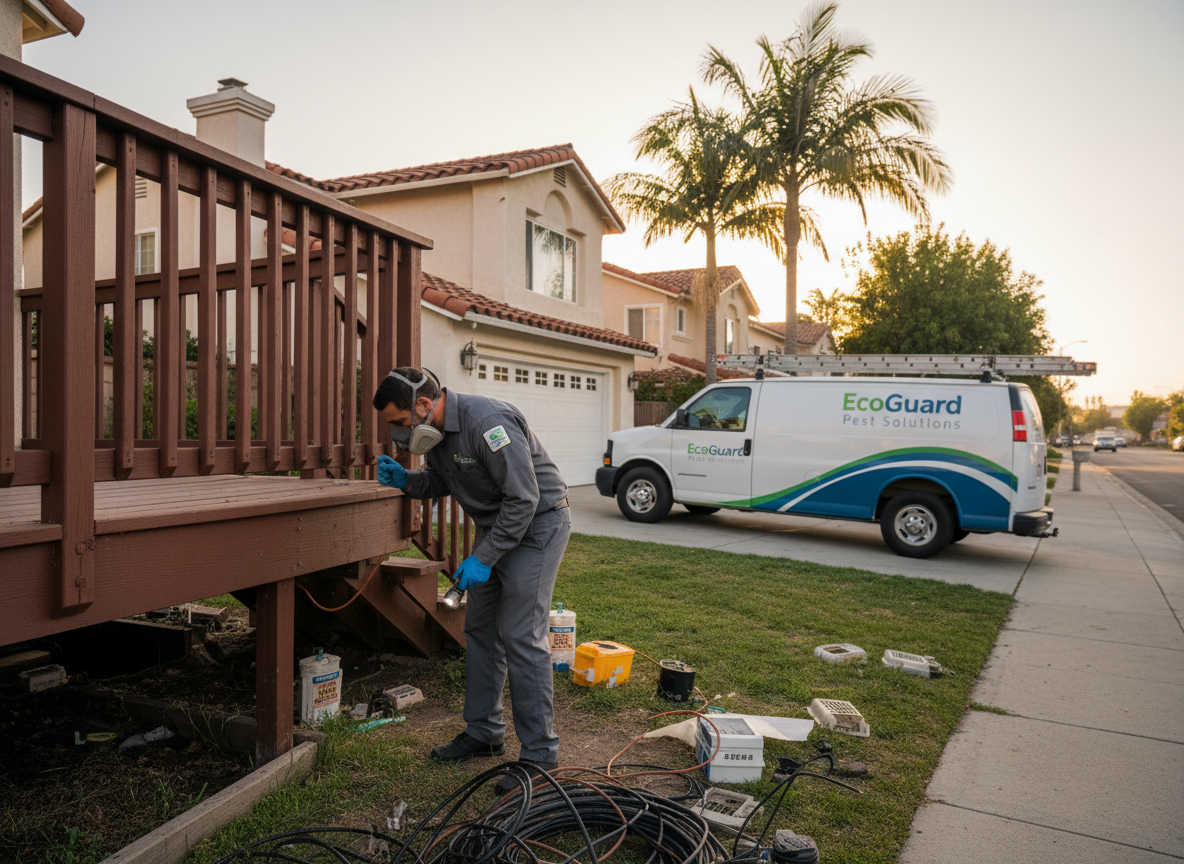
Residential rodent control in California means dealing with three species that behave very differently. Roof rats (Rattus rattus) are the dominant home invader across coastal and Southern California. They are agile climbers that enter along the roofline, travel palm fronds, tree limbs and utility lines, and nest in attics and wall voids. Norway rats (Rattus norvegicus) are heavier ground dwellers that burrow beside foundations, enter through crawl space vents and follow sewer laterals. House mice (Mus musculus) squeeze through a gap the width of a pencil, breed year-round and nest inside kitchen cabinetry, appliance housings and insulation. Identifying which species you have changes where traps go and how tight the exclusion has to be.
The inspection comes before anything else. A technician checks the attic, crawl space, garage, subfloor, roofline, eaves, dryer and bath vents, plumbing and electrical penetrations, and the exterior perimeter. We look for droppings, urine staining under UV, greasy rub marks along runways, gnaw marks on wood and wiring, shredded nesting material and burrow openings. Rats keep to defined travel paths against walls and beams, which is why traps placed on those runways outperform traps scattered across an open attic floor.
Residential Rodent Control Near You — Choose Your City
Every city below has its own local Residential Rodent Control page with coverage details.
Orange County
Los Angeles County
Los Angeles
Alameda County
Riverside County
San Bernardino County
San Diego County
Contra Costa County
Santa Clara County
Fresno County
San Diego
Ventura County
Solano
San Francisco
Sacramento
Kern County
San Joaquin
Stanislaus County
San Bernardino
Ventura
Sonoma
Sacramento County
Monterey
Placer County
Tulare County
Riverside
San Mateo
California's rodenticide rules shape the treatment plan. AB 1788, the California Ecosystems Protection Act, placed a statewide moratorium on most uses of second-generation anticoagulant rodenticides including brodifacoum, bromadiolone, difethialone and difenacoum, after documented secondary poisoning in owls, hawks, bobcats and mountain lions. Legitimate residential work now relies on snap trapping, tamper-resistant stations where permitted, sanitation and physical exclusion rather than broadcast baiting. Any product use follows California Department of Pesticide Regulation labeling, and structural rodent work requires a Structural Pest Control Board license, Branch 2.
Exclusion is the part that actually ends the infestation. Every gap wider than a quarter inch is sealed with 1/4 inch hardware cloth, sheet metal, mortar or copper mesh, with door sweeps fitted to garage and exterior doors. Foam alone does not hold, because rodents chew straight through it. Vent screens, chimney caps and roof-to-fascia gaps get particular attention on tile and shake roofs. After sealing, contaminated insulation and droppings are removed and the area is disinfected rather than dry swept, because rodent waste can carry hantavirus, leptospirosis, salmonellosis and rat-bite fever.
Regional conditions change the emphasis. Coastal and hillside homes see heavy roof rat pressure from mature landscaping and overlapping tree canopies, so vegetation clearance from the roofline matters as much as sealing. Central Valley properties near orchards, vineyards and irrigation see field rodents pushing indoors after harvest and through peak summer heat. Foothill and desert homes deal with ground squirrels and Norway rats burrowing under slabs where soil cracks in dry months. Older pre-1950 housing stock statewide, with wood siding, shallow foundations and unsealed utility chases, needs far more sealing labor than newer slab-on-grade construction.
Technician insight
The mistake almost every homeowner makes is treating rodent control as a trapping problem. Trapping clears the animals that are already inside. If the entry points stay open, a new group moves in within weeks, because California's mild winters mean there is never an off season. The permanent fix is exclusion: seal every gap wider than a quarter inch, screen the vents, and get the tree limbs and palm fronds off the roofline. Homeowners are also frequently sold rodenticide-heavy programs that are no longer appropriate in California under AB 1788, and ultrasonic repellers, which rodents habituate to within days and which have never held up in controlled testing.
Roof rats in a 1930s bungalow attic
A homeowner reported scratching overhead at night and droppings in the garage. Inspection identified roof rats entering at two points: a gap where the fascia met the roof deck, and an unscreened bathroom exhaust vent. A mature pepper tree was overhanging the roof by roughly four feet. Snap traps were set on the attic rafter runways where rub marks were visible. After activity stopped, both entry points were sealed with 1/4 inch hardware cloth and sheet metal, the vent was screened, and roughly forty square feet of contaminated insulation was removed and replaced. The homeowner had the tree cut back to six feet of clearance. The follow-up visit at two weeks found no new droppings.
Residential Rodent Control Services We Offer
✓Attic Rat Removal and Decontamination
Removes roof rats nesting in insulation and rafters, extracts contaminated insulation, disinfects the space and screens all roofline entry points including vents, eaves and fascia gaps.
✓House Mouse Control and Exclusion
Targets Mus musculus in kitchens, pantries, appliance voids and wall cavities. Mouse exclusion requires sealing gaps as small as a quarter inch, tighter than standard rat proofing.
✓Crawl Space and Subfloor Rodent Work
Inspects underfloor areas for Norway rat burrows, moisture, damaged vapor barrier and chewed ductwork, then screens vents and access panels with hardware cloth.
✓Kitchen and Pantry Rodent Exclusion
Seals gaps behind appliances, under sinks and around plumbing penetrations, and covers sanitation: sealed food storage, crumb control and secured indoor waste.
✓Garage and Detached Structure Proofing
Fits door sweeps, seals utility penetrations and addresses stored items and pet food that make garages the most common staging area before rodents move into the house.
✓Roofline and Vegetation Clearance Advice
Identifies tree limbs, palm fronds, ivy and utility lines that give roof rats access, and specifies the clearance needed to cut those routes off.
Residential Rodent Control Cost in California
| Service | Typical Range | What Affects It |
|---|---|---|
| Initial inspection and report | $150-$300 | Higher for multi-story, hillside or difficult-access attic and crawl space properties |
| Trapping and removal program | $250-$650 | Based on infestation level and number of return checks required |
| Exclusion sealing | $400-$1,400 | Driven by entry point count, roof access and whether the home is pre-1950 construction |
| Attic decontamination and insulation replacement | $1,200-$4,500 | Priced by square footage and contamination level, quoted separately |
| Full residential package | $900-$2,000 | Inspection, trapping, exclusion and verification visit combined |
Ranges are typical for California and confirmed with an exact written quote before any work starts.
How it works
- 1
Species Identification and Inspection
Technician inspects attic, crawl space, garage, roofline and exterior perimeter, and identifies whether the property has roof rats, Norway rats or house mice based on droppings, runways, rub marks and burrows. Every entry point is mapped.
- 2
Trapping Along Confirmed Runways
Snap traps and enclosed stations are set on active travel paths, not scattered. Devices are checked on a set schedule and repositioned as activity shifts. Rodenticide use, where appropriate, follows CDPR labeling and AB 1788 restrictions.
- 3
Full Exclusion Sealing
Once activity drops, gaps wider than a quarter inch are closed with 1/4 inch hardware cloth, sheet metal, mortar or copper mesh. Vents are screened, door sweeps fitted and roof-to-fascia gaps closed.
- 4
Sanitation and Decontamination
Droppings, urine-soaked insulation and nesting material are removed and the area disinfected. Contaminated attic insulation is replaced where the load justifies it.
- 5
Follow-Up Verification and Prevention Plan
Return visit one to two weeks later confirms zero new activity, checks every seal, and covers prevention: vegetation clearance, food and waste storage, and what to watch for.
Pricing
Cost depends on home size, construction age, entry point count and whether attic or crawl space access is required. Written quote after inspection, Mon-Fri 8am-6pm and Sat 9am-2pm.