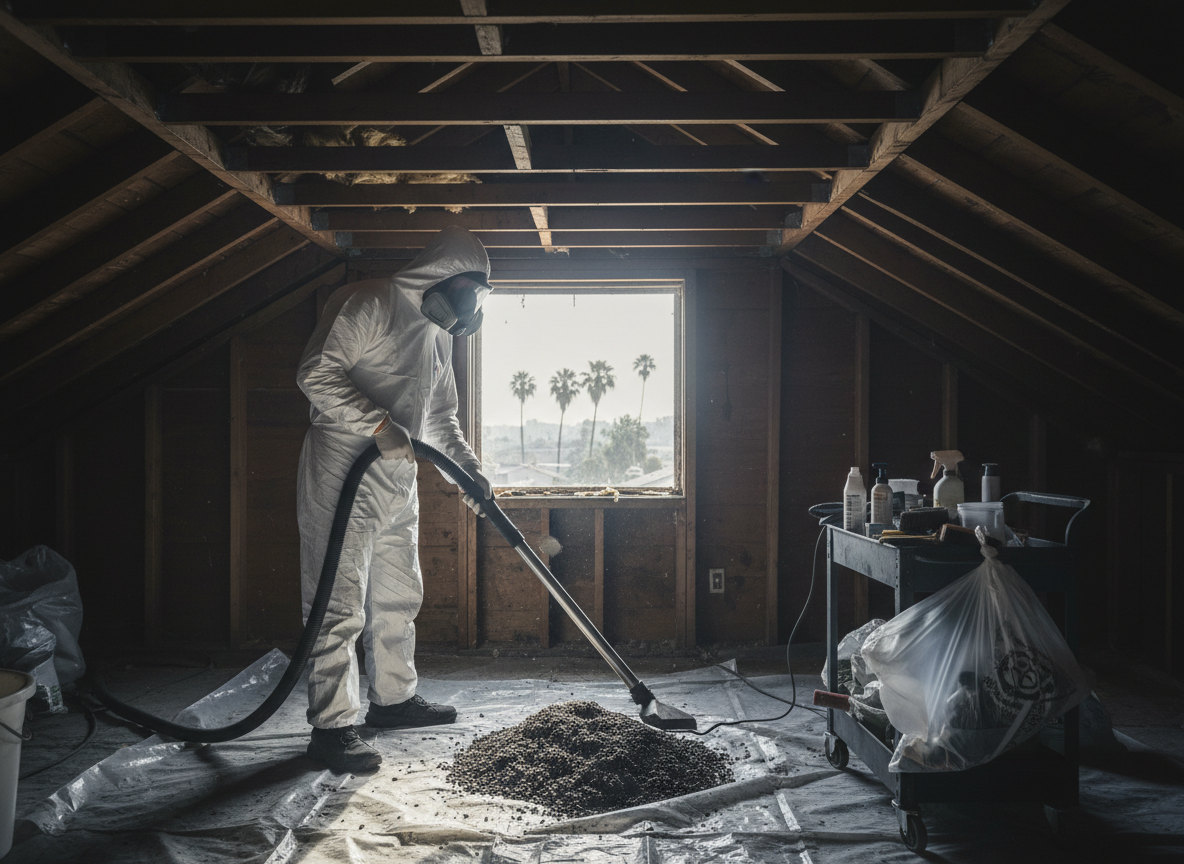
Rodent feces removal is specifically about handling the droppings and urine residue left behind, which is where the actual health risk in a rodent infestation sits. Dried rodent droppings and urine can carry hantavirus, leptospirosis, salmonellosis, lymphocytic choriomeningitis and rat-bite fever. The exposure route that matters is inhalation of aerosolized particulate, which is created the moment dried material is disturbed by sweeping, vacuuming or even walking through it in a confined attic or crawl space. This is why the removal method is the entire point of the service, not an implementation detail.
Droppings also tell you what you are dealing with, which is why identification happens before removal. House mouse droppings measure roughly 1/8 to 1/4 inch, are dark, and have pointed ends. A single mouse produces a large volume, so scattered droppings near food sources and inside cabinetry usually indicate mice. Roof rat droppings run about 1/2 inch with slightly curved, tapered ends and appear along rafters and attic runways. Norway rat droppings are larger at up to 3/4 inch with blunt ends and cluster near burrows, foundations and crawl space access. Fresh droppings are dark and pliable; older ones dry, gray and crumble. That distinction tells us whether the infestation is active.
The safe removal sequence is fixed and follows public health guidance. Ventilate the space for at least thirty minutes before entering. Put on respiratory protection and non-porous gloves. Spray or mist all droppings and contaminated surfaces with a disinfectant solution and allow full contact time so nothing can become airborne. Remove the material wet with a damp towel or wet paper, place it directly into a bag, then double bag. Disinfect the underlying surface. Dispose of gloves and wash hands thoroughly. At no point is dry sweeping or standard vacuuming appropriate.
Volume determines scope. Isolated droppings on a kitchen counter or inside a cabinet are a spot remediation. Accumulated droppings across an attic floor, a crawl space substrate or a storage area represent a much larger job, because the material is bound into insulation and vapor barrier that has to be extracted rather than wiped. Urine is the harder problem in these cases: it saturates porous material, cannot be surface cleaned out of insulation, and leaves pheromone trails that draw new rodents to the same location long after the droppings are gone.
Feces removal is one stage of a complete job. It should follow trapping and exclusion, not precede them, since cleaning while an infestation is active means recontamination within days. It should also be paired with ectoparasite treatment, because fleas and rat mites remain in the substrate after the rodents are gone and migrate toward living space seeking a new host. Where contamination is heavy enough to require insulation or vapor barrier replacement, that falls under the broader rodent cleanup and attic decontamination scope.
Technician insight
People reach for the broom and the shop vacuum, and that is precisely the wrong instinct. Dried rodent droppings are only a serious hazard once you make them airborne, and dry sweeping in an enclosed attic is the most efficient possible way to do that. A household vacuum makes it worse, because it does not capture the fine fraction and exhausts it back into the same room you are standing in. Wet everything down first, wait, then remove it damp. The other thing worth knowing is that the droppings are the visible part and the urine is the part that actually keeps the problem going, because those scent trails tell the next rodent this is a proven place to nest.
Recurring mouse activity in a pantry that had been cleaned repeatedly
A homeowner had wiped down their pantry shelving with household cleaner four separate times over two months, and each time droppings reappeared within a week. Two things were happening. First, the entry point had never been found: a gap around the plumbing penetration behind the pantry wall, roughly half an inch. Second, surface wiping had removed the droppings but never addressed the urine residue on the shelving and along the wall junction, which was still broadcasting a scent trail marking the route as established. The gap was packed with copper mesh and sealed, snap traps were set flush against the shelf edges, the shelving and wall junction were pre-misted, wet cleaned and then treated enzymatically to break down the residue. Nothing reappeared after that.
Rodent Feces Removal Services We Offer
✓Attic Droppings Removal
Wet removal of rat and mouse droppings from attic floors, joists and insulation surfaces, with disinfection of the underlying deck and framing.
✓Crawl Space Feces Removal
Clearing droppings from vapor barrier and underfloor substrate, with contaminated barrier replaced rather than surface cleaned.
✓Kitchen and Cabinet Droppings Cleanup
Removal from cabinetry, pantry shelving, drawer interiors and behind appliances, with food-safe disinfection of all contact surfaces.
✓Garage and Storage Area Cleanup
Droppings removal from stored belongings, shelving and floor areas, including assessment of which contaminated items can be salvaged.
✓Urine Residue and Odor Treatment
Enzymatic breakdown of urine residue and the pheromone trails that draw new rodents to previously infested areas.
✓Ectoparasite Treatment
Treatment for fleas and rat mites that persist in the substrate and insulation after the rodents themselves are gone.
Rodent Feces Removal Cost in California
| Service | Typical Range | What Affects It |
|---|---|---|
| Assessment and identification | $125-$250 | Typically credited toward the work when remediation proceeds |
| Spot droppings removal | $250-$550 | Cabinets, pantry, single room or localized surface contamination |
| Attic droppings removal and disinfection | $600-$1,800 | Surface removal without full insulation extraction, priced by area |
| Crawl space feces removal | $800-$2,500 | Includes contaminated vapor barrier replacement where required |
| Enzymatic urine and odor treatment | $200-$600 | Priced by treated area and residue level |
| Ectoparasite treatment | $200-$500 | Fleas and rat mites remaining in substrate after removal |
Ranges are typical for California and confirmed with an exact written quote before any work starts.
How it works
- 1
Identification and Extent Assessment
Droppings are identified by size and shape to confirm species and whether the activity is current, and the contaminated area is measured to determine scope.
- 2
Ventilation and Containment
The space is ventilated for at least thirty minutes before entry and isolated from occupied living areas. Respiratory protection and non-porous gloves used throughout.
- 3
Disinfectant Pre-Misting
All droppings, urine residue and contaminated surfaces are misted with disinfectant and given full contact time, so nothing becomes airborne when disturbed.
- 4
Wet Removal and Bagging
Material is removed wet and placed directly into bags, then double bagged for disposal. Nothing is dry swept or vacuumed with standard equipment.
- 5
Surface Disinfection and Enzymatic Treatment
Underlying surfaces are disinfected, then treated enzymatically to break down urine residue and eliminate the pheromone trails that attract new rodents.
- 6
Ectoparasite Treatment and Final Check
The area is treated for fleas and rat mites, and the entry points are confirmed sealed so recontamination does not occur.
Pricing
Cost depends on affected area, droppings volume and whether porous material such as insulation requires removal. Written quote after assessment, Mon-Fri 8am-6pm and Sat 9am-2pm.