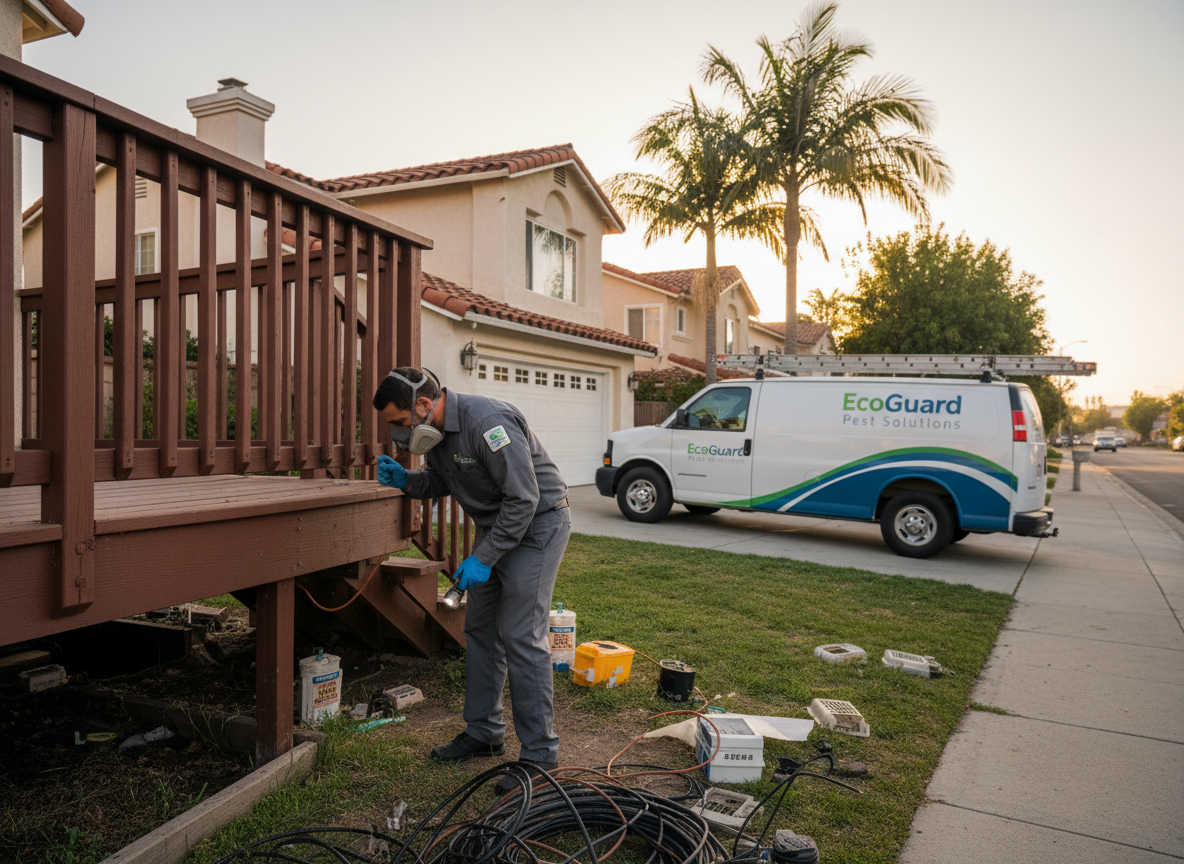
Temecula homes near Temecula Valley Wine Country frequently attract roof rats that feed on fallen grapes and irrigation lines before moving into attics. Older buildings in the Old Town historic district often have foundation gaps and roof vents that allow mice to enter during the dry Mediterranean summers. Properties along I-15 and CA-79 see increased activity when summer heat drives rodents from open fields into crawlspaces and garages near Pechanga Resort.
Residential Rodent Control in Temecula — What We Handle
- ✓Vineyard edges create year-round food sources that differ from typical suburban rodent patterns
- ✓Historic district rules limit certain sealing methods used elsewhere in Riverside County
- ✓Dry summers concentrate calls for work in resort-adjacent neighborhoods and along major roads
Residential Rodent Control Services We Offer in Temecula
✓Attic Rat Removal and Decontamination
Removes roof rats nesting in insulation and rafters, extracts contaminated insulation, disinfects the space and screens all roofline entry points including vents, eaves and fascia gaps.
✓House Mouse Control and Exclusion
Targets Mus musculus in kitchens, pantries, appliance voids and wall cavities. Mouse exclusion requires sealing gaps as small as a quarter inch, tighter than standard rat proofing.
✓Crawl Space and Subfloor Rodent Work
Inspects underfloor areas for Norway rat burrows, moisture, damaged vapor barrier and chewed ductwork, then screens vents and access panels with hardware cloth.
✓Kitchen and Pantry Rodent Exclusion
Seals gaps behind appliances, under sinks and around plumbing penetrations, and covers sanitation: sealed food storage, crumb control and secured indoor waste.
✓Garage and Detached Structure Proofing
Fits door sweeps, seals utility penetrations and addresses stored items and pet food that make garages the most common staging area before rodents move into the house.
✓Roofline and Vegetation Clearance Advice
Identifies tree limbs, palm fronds, ivy and utility lines that give roof rats access, and specifies the clearance needed to cut those routes off.
Residential rodent control in California means dealing with three species that behave very differently. Roof rats (Rattus rattus) are the dominant home invader across coastal and Southern California. They are agile climbers that enter along the roofline, travel palm fronds, tree limbs and utility lines, and nest in attics and wall voids. Norway rats (Rattus norvegicus) are heavier ground dwellers that burrow beside foundations, enter through crawl space vents and follow sewer laterals. House mice (Mus musculus) squeeze through a gap the width of a pencil, breed year-round and nest inside kitchen cabinetry, appliance housings and insulation. Identifying which species you have changes where traps go and how tight the exclusion has to be.
The inspection comes before anything else. A technician checks the attic, crawl space, garage, subfloor, roofline, eaves, dryer and bath vents, plumbing and electrical penetrations, and the exterior perimeter. We look for droppings, urine staining under UV, greasy rub marks along runways, gnaw marks on wood and wiring, shredded nesting material and burrow openings. Rats keep to defined travel paths against walls and beams, which is why traps placed on those runways outperform traps scattered across an open attic floor.
How It Works in Temecula
- 1
Species Identification and Inspection
Technician inspects attic, crawl space, garage, roofline and exterior perimeter, and identifies whether the property has roof rats, Norway rats or house mice based on droppings, runways, rub marks and burrows. Every entry point is mapped.
- 2
Trapping Along Confirmed Runways
Snap traps and enclosed stations are set on active travel paths, not scattered. Devices are checked on a set schedule and repositioned as activity shifts. Rodenticide use, where appropriate, follows CDPR labeling and AB 1788 restrictions.
- 3
Full Exclusion Sealing
Once activity drops, gaps wider than a quarter inch are closed with 1/4 inch hardware cloth, sheet metal, mortar or copper mesh. Vents are screened, door sweeps fitted and roof-to-fascia gaps closed.
- 4
Sanitation and Decontamination
Droppings, urine-soaked insulation and nesting material are removed and the area disinfected. Contaminated attic insulation is replaced where the load justifies it.
- 5
Follow-Up Verification and Prevention Plan
Return visit one to two weeks later confirms zero new activity, checks every seal, and covers prevention: vegetation clearance, food and waste storage, and what to watch for.
Serving All of Temecula
We regularly handle residential rodent control jobs near:
- 📍Temecula Valley Wine Country
- 📍Old Town Temecula
- 📍Pechanga Resort
Residential Rodent Control Pricing in Temecula
Cost depends on home size, construction age, entry point count and whether attic or crawl space access is required. Written quote after inspection, Mon-Fri 8am-6pm and Sat 9am-2pm.
Want the full picture of this service? See our Residential Rodent Control page, or everything we do in Temecula, CA.