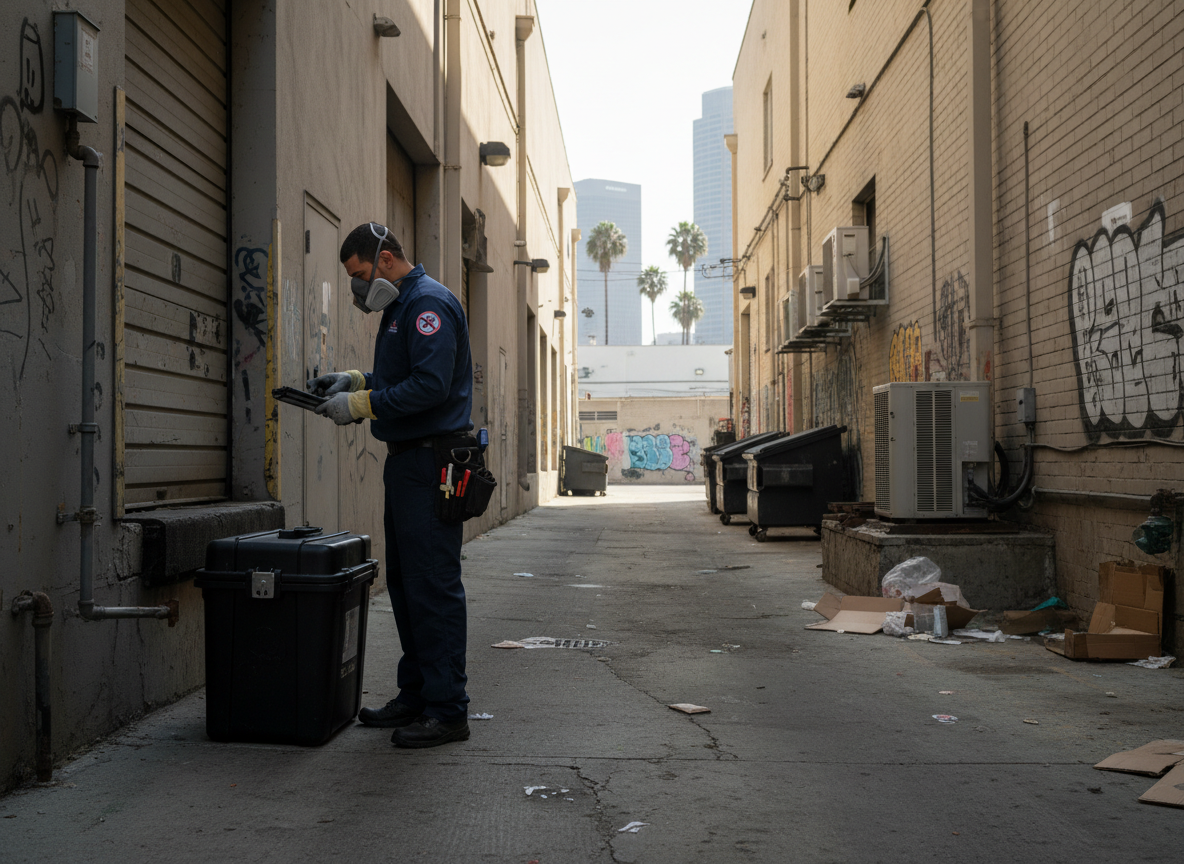
Commercial rodent control in Santa Clarita is a documented Integrated Pest Management program rather than a treatment. Los Angeles County Public Health Environmental Health inspects food facilities here, and inspectors and third-party auditors expect the same evidence: a numbered device map, dated service logs recording findings per device, corrective action records for sanitation and structural deficiencies, and trend data over time.
The commercial profile is shaped by the valley's layout. Business parks, retail centers and light industrial sites frequently back onto undeveloped land, drainage channels or the Santa Clara River corridor, which supplies a continuous population rather than a single intrusion. Roof rats (Rattus rattus) enter over the top through HVAC curb penetrations, unscreened exhaust and intake vents, and gaps at parapet-to-roof-deck junctions, which matters because most commercial stock here is single-story slab construction with substantial roof plant. House mice (Mus musculus) arrive in inbound product and colonize wall voids, dropped ceilings and motor housings.
Two local constraints shape the plan. First, master-planned commercial and mixed-use developments often carry landscaping and exterior appearance rules that limit where exterior devices can sit, so placement is designed around them rather than colliding with them mid-program. Second, the wildland interface means AB 1788 compliance carries real weight: the California Ecosystems Protection Act restricts most second-generation anticoagulant rodenticides precisely because of secondary poisoning in raptors and predators, which are present along these margins. Interior control is mechanical only, and any exterior product use follows California Department of Pesticide Regulation labeling.
Commercial Rodent Control in Santa Clarita — What We Handle
- ✓Business park and retail corridor sites need perimeter device rings where open space borders the property
- ✓Roof level entry dominates: HVAC curbs, parapet junctions and unscreened exhaust vents
- ✓HOA and master-planned landscaping rules constrain exterior device placement, which is worked into the plan
- ✓Interior devices are mechanical only, with no rodenticide in food handling areas
Commercial rodent control in California is a documentation-driven Integrated Pest Management program, not a one-off treatment. Health inspectors, food safety auditors and property managers all expect evidence: a site map showing device placement, a service log with dates and findings, corrective action records and trend data over time. For food-service and food-processing clients operating under California Retail Food Code requirements, that paperwork is often the difference between passing and failing an inspection, which is why every visit is logged rather than just performed.
The species profile drives the program design. Roof rats (Rattus rattus) enter commercial buildings from above: roof penetrations, HVAC curbs, unscreened exhaust and intake vents, and gaps where parapet walls meet the roof deck. Norway rats (Rattus norvegicus) come in low, through dock door gaps, floor drains, utility chases and burrows against the foundation slab. House mice (Mus musculus) arrive in inbound product and pallets, then colonize wall voids, dropped ceilings, motor housings and shelving. A warehouse with a rat problem and a warehouse with a mouse problem need different device types placed in different locations.
Commercial Rodent Control Services We Offer in Santa Clarita
✓Restaurant and Food Service Rodent Programs
Exterior tamper-resistant stations, interior mechanical devices only, exclusion at grease traps, dock and delivery doors, plus sanitation corrective actions and service documentation for health inspections.
✓Warehouse and Distribution Center IPM
Perimeter device rings, inspection aisles along racking, dock leveler and door sweep exclusion, and inbound pallet monitoring for house mice arriving with product.
✓Food Processing Facility Monitoring
Numbered device maps, scheduled service logs, trend reporting and corrective action records built for third-party audit schemes and California Retail Food Code expectations.
✓Office and High-Rise Rodent Control
Inspection of ceiling plenums, riser shafts, break room voids and utility rooms where roof rats travel vertically between floors, with mechanical devices only in occupied space.
✓Retail and Shopping Center Service
Focus on loading bays, trash compactor pads, dumpster enclosures and shared back-of-house corridors where rodents move between tenant suites.
✓Multi-Tenant Building Coordination
Building-level programs that seal shared wall voids, plumbing chases and dropped ceiling connections so treatment in one suite is not undone by the next.
How It Works in Santa Clarita
- 1
Site Assessment and Device Mapping
Full walk of the exterior perimeter, roof, dock and receiving areas, interior production and storage space, and void areas. Species identified, entry points mapped, and a numbered device placement plan produced.
- 2
Exclusion and Structural Correction
Dock door sweeps, roof and HVAC penetration screening, vent covers, floor drain grates, conduit sealing and parapet gap closure using 1/4 inch hardware cloth and sheet metal.
- 3
Device Installation and Baseline
Exterior tamper-resistant stations and interior mechanical multi-catch and snap devices installed to the map. All product use follows CDPR labeling and AB 1788 restrictions.
- 4
Scheduled Monitoring and Documentation
Devices serviced on a set frequency with findings logged per device number. Trend data, corrective actions and sanitation deficiencies recorded for the property manager or auditor.
- 5
Corrective Action Review
Sanitation and structural deficiencies are reported with the responsible party and re-checked each visit until closed, because device programs cannot overcome an ongoing food or harborage source.
Serving All of Santa Clarita
We regularly handle commercial rodent control jobs near:
- 📍Santa Clara River
- 📍Placerita Canyon Natural Area
- 📍Six Flags Magic Mountain
- 📍Central Park
Commercial Rodent Control Pricing in Santa Clarita
Commercial pricing is set by square footage, device count, service frequency and audit documentation requirements. Written quote after site assessment, Mon-Fri 8am-6pm and Sat 9am-2pm.
Want the full picture of this service? See our Commercial Rodent Control page, or everything we do in Santa Clarita, CA.