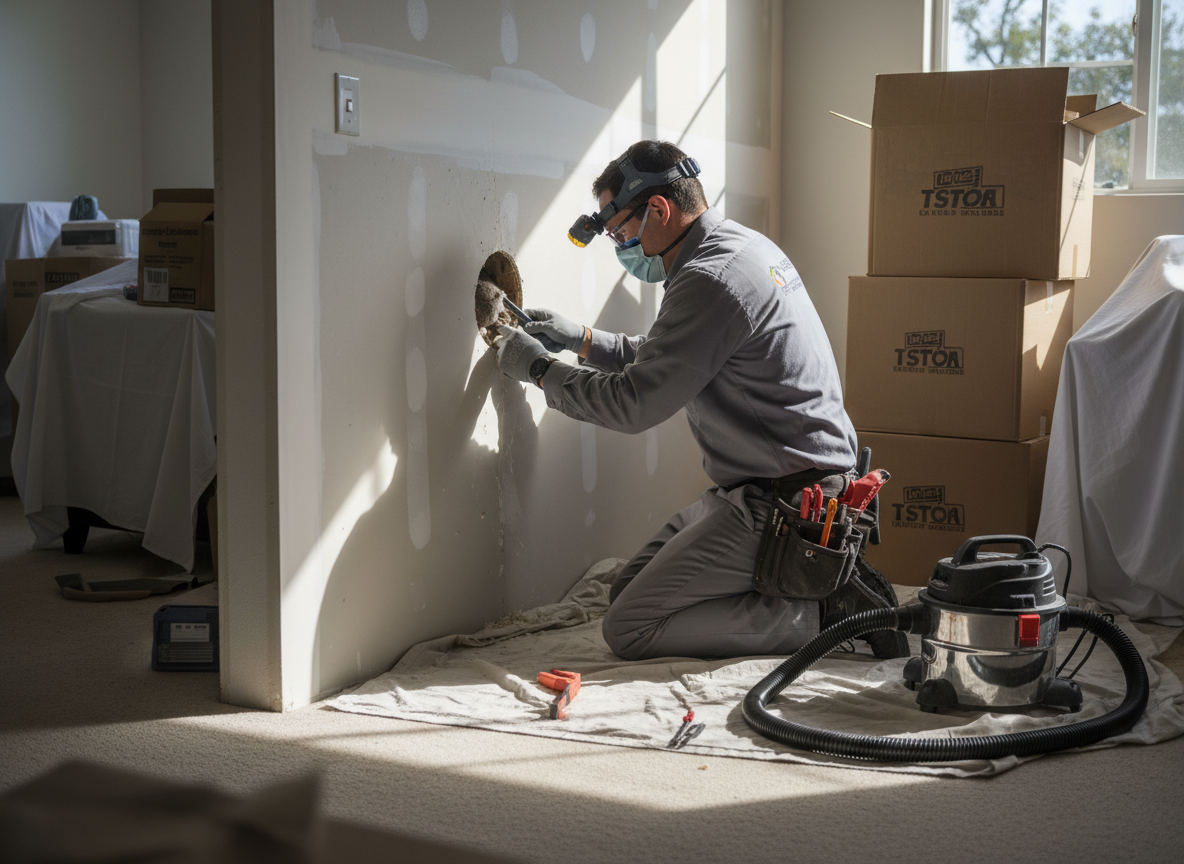
Rodents inside a wall are rarely living in the wall as a destination. A stud bay is a travel corridor and a nesting refuge within a larger system, connected vertically to the attic above and the crawl space or subfloor below, and horizontally through drilled penetrations for plumbing, electrical and HVAC. This is the key thing to understand about wall rodent removal: opening the wall where you hear the noise addresses one point in a network. The complete job identifies where the animals enter the wall system from and closes that, rather than treating the cavity as an isolated space.
Locating the animal inside a wall is the technical part. Scratching heard in a room does not reliably indicate the stud bay it is coming from, since sound conducts along framing and through the cavity. The approach is to narrow it by combining three inputs: the timing and character of the sound, which distinguishes a rat from a mouse and both from a diurnal squirrel; tracking evidence at the top plate and bottom plate where the cavity connects to attic and subfloor; and inspection camera work through small drilled ports rather than exploratory drywall cuts. It is common to place two or three quarter-inch inspection holes before any larger access is created.
The distinction between a live animal and a dead one changes the entire approach. Live rodents in a wall are best resolved by trapping at the cavity's connection points, at the top plate in the attic and the bottom plate in the crawl space, letting the animal exit into a trap rather than cutting the wall at all. This resolves a substantial proportion of wall cases with no drywall work whatsoever. A dead rodent, indicated by decomposition odor, blow fly activity and the absence of movement sounds, requires physical extraction, since the carcass will otherwise produce three to six weeks of odor.
Where access must be created, it is made as small as the job allows and placed thoughtfully. Openings go in inconspicuous locations where possible: inside a closet, behind furniture, low on the wall below where a baseboard will cover the repair, or in an adjacent utility space. The cavity is cleared of the animal, nesting material and any contaminated insulation, pre-misted with disinfectant rather than disturbed dry, treated enzymatically to break down urine residue and decomposition compounds, and treated for ectoparasites since fleas and rat mites migrate out of the cavity toward living space once the host is gone. The opening is then patched.
Sealing the cavity's connections is what prevents recurrence. Top plate penetrations in the attic and bottom plate penetrations in the crawl space, drilled for plumbing, electrical and HVAC and almost never sealed by the original trades, are the highways that make wall voids accessible in the first place. These are packed with copper mesh and sealed, or covered with sheet metal where the opening is large. Beyond that the structure's exterior entry points still need addressing, because rodents in a wall got into the building somewhere, and wall removal without exclusion simply relocates the problem to the next cavity.
Technician insight
The instinct when you hear something in the wall is to cut the drywall where the sound is loudest, and it is almost always wrong. Sound travels along framing and through the cavity, so the noise you hear in the bedroom can easily be an animal two stud bays over in the hallway wall. That is how people end up with four patched holes and no rodent. Narrow it properly first, with plate tracking and a camera through a quarter-inch port, and cut once. The other thing worth knowing is that if the animal is alive and still moving, you often do not need to cut at all. Trap at the top plate in the attic and the bottom plate in the crawl space, because that is how it gets in and out, and let it come to you.
Scratching in a bedroom wall with no dead rodent odor
The occupant reported scratching inside a bedroom wall starting around an hour after dark, continuing intermittently through the night, for about ten days. There was no odor, and the movement confirmed a live animal. Rather than opening the bedroom wall, the attic was inspected above that wall line and found droppings and clear tracking around an unsealed top plate penetration where a plumbing vent stack passed through, with roof rat rub marks on the adjacent framing. The crawl space showed corresponding activity at the bottom plate. Snap traps were set at both plate connections and inside the attic on the rafter runway. The rat was taken at the top plate on the third night, and a second one two nights later. No drywall was cut at any point. The top plate penetration was then packed with copper mesh and sealed with sheet metal, the corresponding bottom plate penetration sealed, and the roof survey identified and closed the fascia gap that had allowed attic access initially. The two-week verification found nothing.
Wall Rodent Removal Services We Offer
✓Wall Void Location and Diagnosis
Narrowing the affected stud bay using sound character and timing, top and bottom plate tracking evidence, and inspection camera work through minimal ports.
✓Live Rodent Extraction Without Cutting
Trapping at the cavity's top and bottom plate connections so the animal exits into a device, resolving many wall cases with no drywall work at all.
✓Dead Rodent Extraction From Walls
Locating and physically removing carcasses causing decomposition odor, with minimal access placed in the least conspicuous workable location.
✓Nesting Material and Insulation Removal
Clearing nesting material and contaminated cavity insulation, with disinfectant pre-misting rather than dry disturbance.
✓Top and Bottom Plate Sealing
Packing and sealing the plumbing, electrical and HVAC penetrations through top and bottom plates that make wall cavities accessible from attic and crawl space.
✓Odor and Ectoparasite Treatment
Enzymatic treatment of urine and decomposition residue in the cavity, plus treatment for fleas and rat mites migrating out toward living space.
✓Access Repair
Patching and finishing the access opening after the cavity work is complete.
Wall Rodent Removal Cost in California
| Service | Typical Range | What Affects It |
|---|---|---|
| Diagnosis and cavity location | $150-$325 | Includes inspection camera work; typically credited toward the removal |
| Live extraction by plate trapping | $250-$550 | Resolves many wall cases without any drywall cutting |
| Wall access and carcass extraction | $350-$800 | Includes creating the access opening; multiple exploratory points increase cost |
| Cavity decontamination and odor treatment | $200-$550 | Nesting removal, disinfection, enzymatic treatment and ectoparasite treatment |
| Top and bottom plate sealing | $300-$800 | Driven by number of penetrations and attic or crawl space access |
| Drywall access repair | $150-$400 | Patch and finish; texture and paint matching quoted separately |
Ranges are typical for California and confirmed with an exact written quote before any work starts.
How it works
- 1
Sound Assessment and Species Identification
Timing and character of the noise assessed to distinguish rat from mouse and both from a diurnal squirrel, which changes the approach entirely.
- 2
Cavity Location
Top plate and bottom plate checked from attic and crawl space for tracking, droppings and rub marks, then inspection camera work through quarter-inch ports to confirm the specific stud bay.
- 3
Live or Dead Determination
Movement sounds indicate a live animal, which is often resolvable by trapping at the plate connections without cutting. Odor and blow fly activity indicate a carcass requiring extraction.
- 4
Trapping or Minimal Access
Live cases trapped at cavity connection points. Where extraction is required, the smallest workable opening is created in the least conspicuous location available.
- 5
Cavity Clearing and Decontamination
Animal, nesting material and contaminated insulation removed after disinfectant pre-misting, then enzymatic treatment for urine and decomposition residue and ectoparasite treatment.
- 6
Plate Sealing and Repair
Top and bottom plate penetrations packed with copper mesh and sealed, exterior entry points addressed, and the access opening patched.
Pricing
Cost depends on how accessible the cavity is, whether cutting is required, and how many plate penetrations need sealing. Written quote after diagnosis, Mon-Fri 8am-6pm and Sat 9am-2pm.