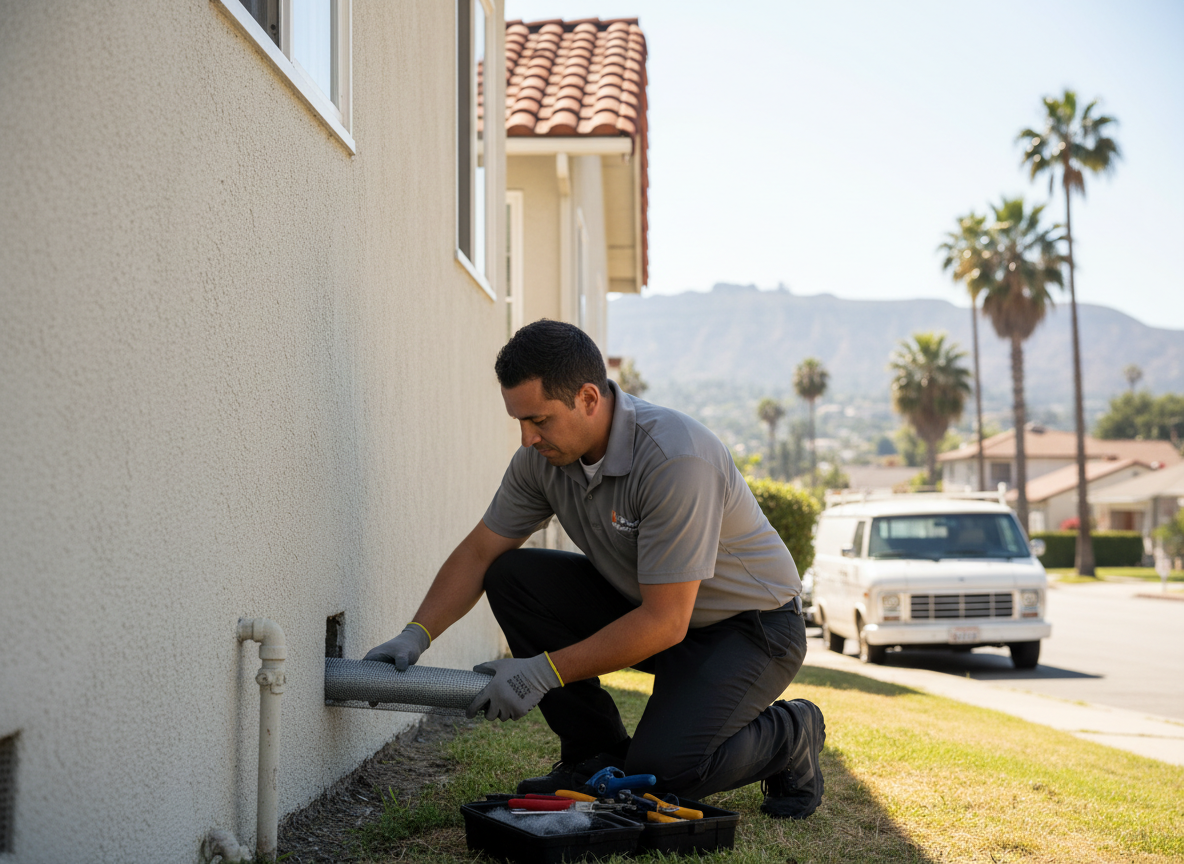
Rodent proofing, also called exclusion, is the only part of rodent control that produces a permanent result. Trapping removes the animals currently inside. Exclusion closes the openings that let them in, which is what stops the cycle. The governing measurements are simple and unforgiving: an adult house mouse passes through a gap of about a quarter inch, roughly the width of a pencil, and a young rat through half an inch. Rodents also gnaw, with incisors that grow continuously and register around 5.5 on the Mohs hardness scale, which is why they cut through expanding foam, plastic, wood, drywall, vinyl and soft mortar without difficulty.
Material choice therefore decides whether the work holds. The materials that work are 1/4 inch galvanized hardware cloth, sheet metal and flashing, copper or stainless mesh, cement mortar and concrete, and metal-backed door sweeps. The materials that fail are expanding foam used alone, steel wool used alone since it rusts and compresses, screening finer than hardware cloth which tears, plastic vent covers, caulk and duct tape. Foam has a legitimate role as a backing and sealant behind or around metal, but on its own it is a delay rather than a solution.
The entry points are predictable once you know where to look. Along the roofline: gaps at roof-to-fascia junctions, unscreened gable and soffit vents, tile roof end gaps, chimney openings without caps, and any point where a tree limb, palm frond, ivy run or utility line touches the structure and gives roof rats a bridge. At ground level: garage door bottoms with worn seals, crawl space vents and access panels, foundation cracks, gaps at siding-to-foundation junctions, and utility trenches. Throughout: plumbing and electrical penetrations, gas line entries, dryer and bathroom exhaust vents, AC line sets, and openings behind and beneath appliances.
Vegetation and site conditions are part of proofing, not a separate topic. Roof rats reach roofs almost entirely by climbing. Tree limbs need clearance from the roofline, palms need fronds cleared since dead frond skirts are a preferred roof rat nesting site in California, ivy and dense climbing vegetation on walls provide both cover and a route, and fruit trees dropping unpicked fruit provide the food supply that supports the population in the first place. Sealing a structure while leaving a branch resting on the eave is incomplete work.
Rodent proofing is also the correct sequencing question. Sealing a structure that still contains an active infestation traps rodents inside, which produces dead rodents in wall voids and weeks of decomposition odor. The order is inspection, then trapping until activity ceases, then exclusion sealing, then verification. The exception is a preventive proofing job on a structure with no current activity, which can proceed directly to sealing. Proofing done properly is a one-time capital expense rather than the recurring service fee that a device-only program becomes.
Technician insight
Two mistakes account for most failed rodent proofing. The first is material: expanding foam. It goes in fast, it looks finished, and a rat is through it in a week. Rodent incisors handle materials far harder than cured foam, which is why anything that has to hold needs metal in it. The second is sealing while the infestation is still active, which traps rodents in the wall and turns a proofing job into a dead rodent removal job. The order matters. Clear the structure first, then seal it. And check the roofline before assuming the problem is at ground level, because in most of California the species doing the damage is a roof rat, and it is coming in from above.
Whole-structure proofing on a 1940s home with repeat infestations
A property had been treated for rodents three separate times across four years by two different companies, each time with trapping only. The full survey found eleven distinct entry points. The significant ones were an unscreened gable vent, a gap of roughly one and a half inches where the roof deck met the fascia along the rear elevation, a crawl space access panel that no longer sat flush, a garage door with a fully worn bottom seal, and two utility penetrations where earlier foam repairs had been chewed through cleanly. A mature avocado tree overhung the roof by around six feet and dropped fruit that was not being cleared. Trapping ran first until activity stopped over nine days. All eleven points were then sealed with 1/4 inch hardware cloth, sheet metal and copper mesh, the vents were screened, a metal-backed sweep was fitted to the garage door, and the owner cut the tree back and began clearing fallen fruit. There has been no activity since.
Rodent Proofing Services We Offer
✓Roofline and Attic Exclusion
Sealing roof-to-fascia gaps, screening gable and soffit vents with 1/4 inch hardware cloth, closing tile roof end gaps and fitting chimney caps.
✓Crawl Space and Foundation Proofing
Screening crawl space vents, securing access panels, sealing foundation cracks and siding-to-foundation junctions against Norway rat entry.
✓Garage and Door Sealing
Fitting metal-backed door sweeps and threshold seals to garage and exterior doors, the single most common ground level entry point in California homes.
✓Utility Penetration Sealing
Closing gaps around plumbing, gas, electrical, AC line set and cable penetrations using copper mesh backed with sealant or sheet metal collars.
✓Vent and Exhaust Screening
Screening dryer, bathroom, kitchen and attic exhaust vents with rodent-resistant covers that maintain required airflow.
✓Vegetation Clearance Assessment
Identifying tree limbs, palm frond skirts, ivy runs and utility lines giving roof rats access, with specified clearance requirements.
✓Commercial Building Exclusion
Dock door sweeps, roof and HVAC penetration sealing, floor drain grates and demising wall closure for warehouses, restaurants and multi-tenant properties.
Rodent Proofing Cost in California
| Service | Typical Range | What Affects It |
|---|---|---|
| Structural survey and entry point report | $150-$300 | Typically credited toward the proofing work when it proceeds |
| Partial exclusion, targeted points | $300-$800 | Addressing a defined set of entry points rather than the full structure |
| Full residential exclusion | $800-$2,500 | Whole-structure seal; pre-1950 homes with wood siding sit at the higher end |
| Vent and door hardware package | $250-$700 | Rodent-resistant vent covers plus metal-backed sweeps on garage and exterior doors |
| Commercial exclusion | $1,200-$5,000 | Dock doors, roof penetrations, utility chases and demising walls, driven by building size |
Ranges are typical for California and confirmed with an exact written quote before any work starts.
How it works
- 1
Full Structural Survey
Complete exterior circuit at ground and roof level, plus attic, crawl space and garage interior. Every gap wider than a quarter inch is located, photographed and logged.
- 2
Activity Confirmation
We confirm whether rodents are currently inside before sealing, because sealing an active infestation traps animals in wall voids and creates a dead rodent problem.
- 3
Scope and Materials Plan
You receive the list of entry points with the specific material proposed for each: hardware cloth, sheet metal, copper mesh, mortar or door sweep, plus any vegetation clearance required.
- 4
Sealing Work
Each point is closed with the appropriate rodent-resistant material, fitted to the existing building profile. Foam is used only as backing or sealant around metal, never alone.
- 5
Vent and Door Hardware
Vents screened with rodent-resistant covers that maintain airflow. Metal-backed sweeps and threshold seals fitted to garage and exterior doors.
- 6
Verification Walkthrough
Completed work is walked with the property owner, every sealed point is shown, and the remaining prevention items such as vegetation clearance and waste storage are covered.
Pricing
Proofing cost is driven by entry point count, roof and crawl space access difficulty, and building age. Written quote after survey, Mon-Fri 8am-6pm and Sat 9am-2pm.