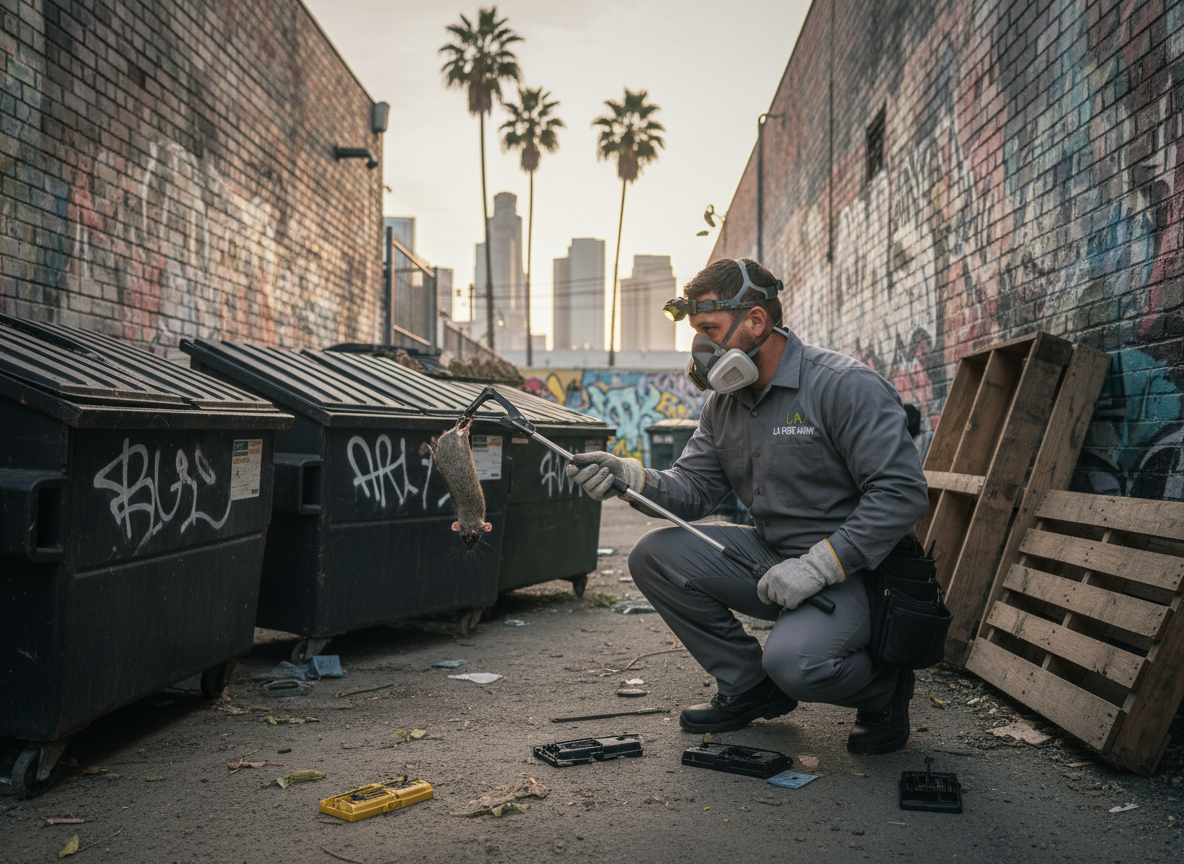
Rat removal in California means dealing with two species that require completely different treatment plans. Roof rats (Rattus rattus), also called black rats, are agile climbers with tails longer than their head and body, and they enter structures from above: along roof-to-fascia gaps, unscreened gable and soffit vents, tile roof end gaps and uncapped chimneys, reaching the roof via tree limbs, palm frond skirts, ivy runs, fence lines and utility cables. Norway rats (Rattus norvegicus) are heavier, stockier ground dwellers with shorter tails, and they enter low: through crawl space and foundation vents, foundation cracks, floor drains and sewer laterals, burrowing against footings and slabs. Roof rats dominate coastal and Southern California and much of the Central Valley. Confusing the two puts traps at the wrong height entirely.
Identification happens before any device is placed. Roof rat droppings run about half an inch with slightly curved, tapered ends and appear along attic rafters and top plates. Norway rat droppings run up to three quarters of an inch with blunt ends and cluster near burrow openings, which are two to four inches across and found against foundations. Both species leave greasy rub marks where fur repeatedly contacts framing, visible runways in dust and insulation, and gnaw damage with paired incisor grooves. Nocturnal activity concentrated in the hours after dusk and before dawn confirms rats rather than diurnal squirrels.
Trap placement is the technical skill in rat removal and the reason DIY efforts stall. Rats exhibit neophobia, avoiding unfamiliar objects in open space for several days after they appear. Traps scattered across an open attic floor are precisely what a rat routes around. Devices go flush against rafters, top plates and walls on runways confirmed by rub marks and droppings, with the trigger oriented toward the wall so the rat crosses it on its established path. Devices are checked on a set schedule and repositioned as the activity pattern shifts, rather than set once and left.
California law and practical experience both point away from bait. AB 1788, the California Ecosystems Protection Act, placed a statewide moratorium on most uses of second-generation anticoagulant rodenticides including brodifacoum, bromadiolone, difethialone and difenacoum, after documented secondary poisoning in raptors, bobcats and mountain lions. Independently of the law, a poisoned rat almost always dies inside a wall void or attic cavity, which converts a rat removal job into a dead rodent removal job plus three to six weeks of decomposition odor, blow flies, and a flush of rat mites migrating into living space. Trapping recovers the carcass. Any product use follows California Department of Pesticide Regulation labeling, and the work requires a Structural Pest Control Board license, Branch 2.
Removal is finished only when the building is sealed. Roof rat work concentrates on the roofline: fascia gaps, vent screening with quarter-inch hardware cloth, tile end closures, chimney caps, and clearance of the tree limbs and dead palm frond skirts that provided access. Norway rat work concentrates at grade: foundation vent screening, access panel reseal, foundation crack mortaring and floor drain grates. After sealing, droppings and urine-contaminated insulation are pre-misted with disinfectant and removed wet rather than dry swept, because rat waste can carry hantavirus, leptospirosis, salmonellosis and rat-bite fever. A verification visit one to two weeks later confirms zero new activity.
Technician insight
The single most common thing I fix on a rat job is trap placement. People set six traps in the middle of the attic floor, catch nothing for two weeks, and conclude the rats are too smart. The rats are not smart, they are neophobic, and they are walking a fixed route along the rafter where you can see the grease marks. Put the trap flush on that route with the trigger toward the wood and you will have the rat in two nights. The second thing is height. If you have roof rats and you are treating at ground level, you are working the wrong half of the building. Check the fascia line from a ladder before you do anything else, because that gap is invisible from the ground and it is where most California roof rats come in.
Five weeks of DIY trapping with one catch
A homeowner reported heavy scratching above a bedroom ceiling and had been running store-bought snap traps in the attic for five weeks with a single catch. The inspection found the problem immediately: eight traps sitting in the open across the attic floor, and a well-established roof rat runway along a rafter above them with clear greasy rub marks and a droppings line. The traps were on the floor; the rats were four feet above, travelling the framing. Traps were repositioned flush on the rafter with triggers facing the wood. Three roof rats were taken in the first four nights and a fourth on the ninth. The entry was a gap where the roof deck met the fascia along the rear elevation, plus a gable vent with corroded screening. Both were sealed with sheet metal and quarter-inch hardware cloth, contaminated insulation near the nest was extracted and replaced, and a queen palm eight feet from the eave had its dead frond skirt cleared. Verification at two weeks was clear.
Rat Removal Services We Offer
✓Roof Rat Removal
Removal of Rattus rattus from attics, soffits and upper wall voids using rafter and top plate runway trapping, followed by roofline exclusion.
✓Norway Rat Removal
Removal of Rattus norvegicus from crawl spaces, basements and foundation burrows, with trapping at burrow entrances and grade-level sealing.
✓Attic Rat Trapping and Cleanup
Rafter and top plate trapping, contaminated insulation extraction, and screening of vents, eaves and roof-to-fascia gaps with quarter-inch hardware cloth.
✓Burrow Treatment and Foundation Sealing
Locating and treating burrow networks in crawl space substrate and against footings, with vent screening and access panel reseal.
✓Wall Void Rat Trapping
Trapping at top plate and bottom plate connections so rats travelling inside wall cavities are taken without cutting drywall.
✓Roof Access Route Clearance
Clearance specification for tree limbs, dead palm frond skirts, ivy runs and utility drops that give roof rats access to the roof.
Rat Removal Cost in California
| Service | Typical Range | What Affects It |
|---|---|---|
| Inspection and species identification | $125-$275 | Confirms roof rat or Norway rat; higher where attic or crawl access is restricted |
| Roof rat removal program | $300-$700 | Attic and roofline trapping, based on infestation level and number of device checks |
| Norway rat removal program | $300-$700 | Crawl space and burrow trapping, priced by burrow count and access clearance |
| Exclusion sealing | $400-$1,400 | Roofline or foundation depending on species; driven by entry point count and access |
| Decontamination and insulation replacement | $450-$1,500 | Droppings removal, disinfection and contaminated insulation, quoted by square footage |
Ranges are typical for California and confirmed with an exact written quote before any work starts.
How it works
- 1
Species Identification
Attic, crawl space, garage, roofline and exterior perimeter inspected to confirm roof rat or Norway rat from droppings, rub marks, runways, burrows and activity timing. Every entry point mapped.
- 2
Runway Trap Placement
Snap traps set flush against rafters, top plates and walls on runways with visible rub marks, trigger facing the wall, because rats route around unfamiliar objects placed in open space.
- 3
Scheduled Checks and Carcass Recovery
Devices checked on a set schedule, carcasses recovered on each visit, and placement adjusted as the activity pattern shifts until consecutive checks show zero catches.
- 4
Species-Appropriate Exclusion
Roof rats: fascia gaps, vents, tile ends and chimney sealed, plus tree and palm clearance. Norway rats: foundation vents, access panels, cracks and floor drains sealed. All with quarter-inch hardware cloth and sheet metal.
- 5
Decontamination
Droppings, nesting material and urine-contaminated insulation pre-misted with disinfectant and removed wet, then treated enzymatically to break the pheromone trails that draw new rats back.
- 6
Verification
Return visit one to two weeks later confirms no fresh droppings, gnaw marks or runway activity, and every seal is re-checked.
Pricing
Rat removal cost is set by species, infestation level, structure size and how much exclusion is required. Written quote after inspection, Mon-Fri 8am-6pm and Sat 9am-2pm.