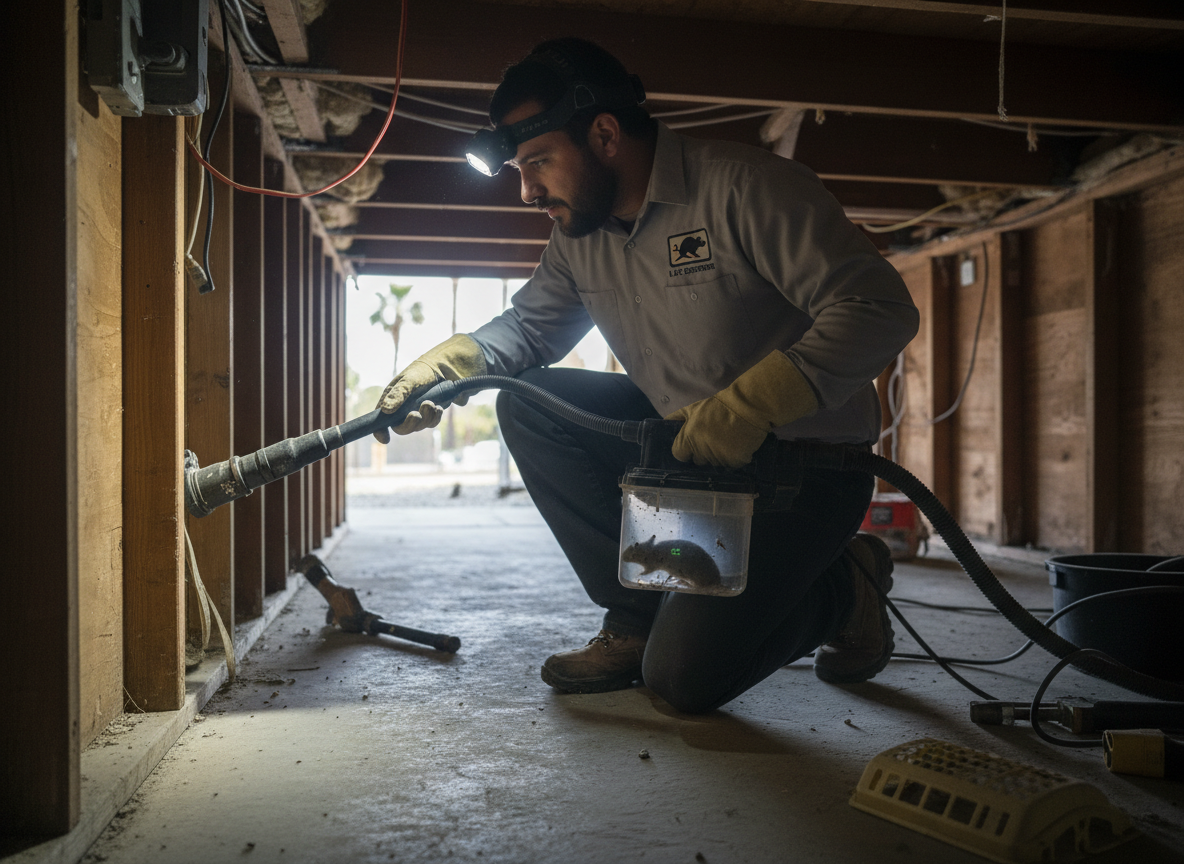
Mice removal is a different discipline from rat removal, and the difference comes down to two numbers. The first is a quarter inch, which is the gap an adult house mouse (Mus musculus) can pass through, roughly the width of a pencil. A mouse skull is the limiting dimension and the skeleton is flexible, so if the head fits, the mouse is inside. Rat exclusion works to a half-inch standard; mouse exclusion has to be tighter, which means a building that is rat-proof is frequently not mouse-proof. The second number is the home range: a house mouse typically travels only a few feet from its nest, so devices have to be placed close together and close to the harborage rather than spread across a room.
The breeding rate is what makes mice removal a program rather than an event. A female house mouse reaches sexual maturity in around six weeks and can produce five to ten litters a year of five to six young each. That means a population rebuilds faster than it can be trapped down if the removal is casual or intermittent, and it is the main reason mice removal typically requires more return visits than rat removal. It is also why sanitation and exclusion carry proportionally more weight with mice: reducing the food supply and closing the gaps limits how large the population can get between visits.
Identification is straightforward once you know the markers. House mouse droppings measure an eighth to a quarter inch, are dark and have pointed ends, and appear in large numbers close to food sources, inside cabinetry, drawers and appliance housings. Rat droppings are half to three quarters of an inch with blunter ends. Mice also leave fine gnaw damage on packaging, shredded nesting material made from insulation, cardboard and fabric, and a distinctive musky urine odor in enclosed cabinet spaces. Activity is nocturnal, lighter and faster-sounding than rats, and more continuous through the night.
The kitchen is where mice are noticed and almost never where they live. The population is usually based in the attached garage, the crawl space, the attic or a wall void, and travels in for food through unsealed plumbing and gas penetrations, dishwasher and refrigerator water line entries, gaps at the cabinet toe kick, and openings around electrical boxes. This is the reason so many homeowners trap mice in the kitchen for months without progress. Effective mice removal traces the route backward to the source and treats both locations at the same time, rather than catching individuals at the destination.
Exclusion for mice is detail work. Every gap wider than a quarter inch is packed with copper mesh and sealed, or covered with quarter-inch hardware cloth or sheet metal. Expanding foam alone fails because mice gnaw straight through it, and steel wool alone degrades as it rusts and compresses. Garage door bottom seals, especially at the corners, are the most common ground-level failure. After sealing, droppings and nesting material are pre-misted with disinfectant and removed wet rather than dry swept, because mouse waste can carry hantavirus, leptospirosis, salmonellosis and lymphocytic choriomeningitis, and urine residue is treated enzymatically to break the pheromone trails that mark the route as established.
Technician insight
If you are catching mice week after week and the catches never taper off, the population is not in the room you are trapping. Mice go where the food is, so the kitchen is the destination, not the address. Nine times out of ten the colony is in the attached garage behind stacked cardboard with a failed door seal, or in the crawl space, and until you treat there you are just intercepting commuters. The other thing worth internalizing is the quarter inch. People seal what looks like a hole and leave what looks like a gap, and the gap behind the dishwasher supply line is exactly the right size. If you can slide a pencil in, a mouse can get in, and it needs copper mesh and sealant, not a squirt of foam.
Eleven weeks of steady kitchen catches that never dropped
A homeowner had been trapping mice in their kitchen for eleven weeks. They were catching two or three a week consistently, which they read as progress, but the number never dropped. The inspection found droppings in the lower cabinets and behind the range, and the entry into the kitchen was a gap around the gas line penetration behind the range, roughly half an inch, connecting to the wall void. Following that void led to the attached garage, which was the actual problem: around twenty cardboard boxes stacked against the shared wall with heavy droppings and a nest behind them, an open forty pound bag of dog food on the floor, and a garage door bottom seal that had hardened and pulled away at both corners leaving three-quarter-inch gaps. The program ran trapping in the garage at high density as well as the kitchen, fitted a metal-backed door seal and threshold, packed the gas line penetration and two under-sink penetrations with copper mesh, and the owner moved the dog food to a sealed container and switched to plastic bins. Catches stopped after nine days and the verification visit at two weeks found no fresh droppings.
Mice Removal Services We Offer
✓Kitchen and Pantry Mouse Removal
Trapping and removal from cabinet voids, pantry shelving, drawer interiors and toe kick runs, using food-safe mechanical devices only.
✓Appliance Void Nest Removal
Pulling refrigerators, ranges and dishwashers forward to remove nests from compressor compartments and insulated cavities, with gnaw damage documented.
✓Garage Source Treatment
Trapping at the garage harborage that most kitchen mouse problems originate from, plus metal-backed door seal and threshold fitting.
✓Wall Void Mouse Trapping
Trapping at top and bottom plate connections so mice travelling inside wall cavities are taken without cutting drywall.
✓Quarter-Inch Exclusion Sealing
Sealing every gap wider than a quarter inch with copper mesh, hardware cloth and sheet metal, tighter than the half-inch standard rat work uses.
✓Droppings Cleanup and Pheromone Treatment
Wet removal of droppings and nesting material with food-safe disinfection, plus enzymatic treatment of the urine trails that mark established routes.
Mice Removal Cost in California
| Service | Typical Range | What Affects It |
|---|---|---|
| Inspection and source tracing | $125-$250 | Includes pulling kitchen appliances forward and identifying the upstream harborage |
| Mice removal program | $200-$500 | Higher device count over more return visits than rat work, due to breeding rate and short home range |
| Upstream source treatment | $300-$900 | Garage, crawl space or attic trapping where the colony is actually based |
| Quarter-inch exclusion sealing | $350-$1,200 | Copper mesh, hardware cloth and door seals; driven by penetration count and cabinet access |
| Decontamination and enzymatic treatment | $250-$700 | Droppings removal, food-safe disinfection and pheromone trail treatment |
Ranges are typical for California and confirmed with an exact written quote before any work starts.
How it works
- 1
Identification and Extent Mapping
Droppings confirmed as house mouse by size and pointed ends, and the contaminated areas mapped: cabinetry, pantry, appliance voids, drawers and wall junctions.
- 2
Source Tracing
The route is traced backward from the kitchen to the actual harborage, typically the attached garage, crawl space, attic or a wall void, because mice removal at the destination alone does not resolve a colony.
- 3
High-Density Trap Placement
Snap traps set flush against wall and cabinet runways with the trigger toward the wall, placed close together and close to harborage because mice range only a few feet from the nest. Enclosed devices used inside cabinets where children or pets are present.
- 4
Scheduled Checks Through the Breeding Cycle
Devices checked on a set schedule across more return visits than rat work requires, since a female house mouse can produce five to ten litters a year and the program has to outpace the breeding rate.
- 5
Quarter-Inch Exclusion Sealing
Every gap wider than a quarter inch packed with copper mesh and sealed or covered with hardware cloth and sheet metal. Plumbing, gas, dishwasher and refrigerator line penetrations, toe kick gaps and garage door seals addressed.
- 6
Decontamination and Sanitation Plan
Droppings and nesting material pre-misted with disinfectant and removed wet, contact surfaces disinfected food-safe, and urine residue treated enzymatically to break the pheromone trails.
Pricing
Mice removal cost is set by infestation level, how many penetrations require sealing and whether an upstream source area also needs treatment. Written quote after inspection, Mon-Fri 8am-6pm and Sat 9am-2pm.