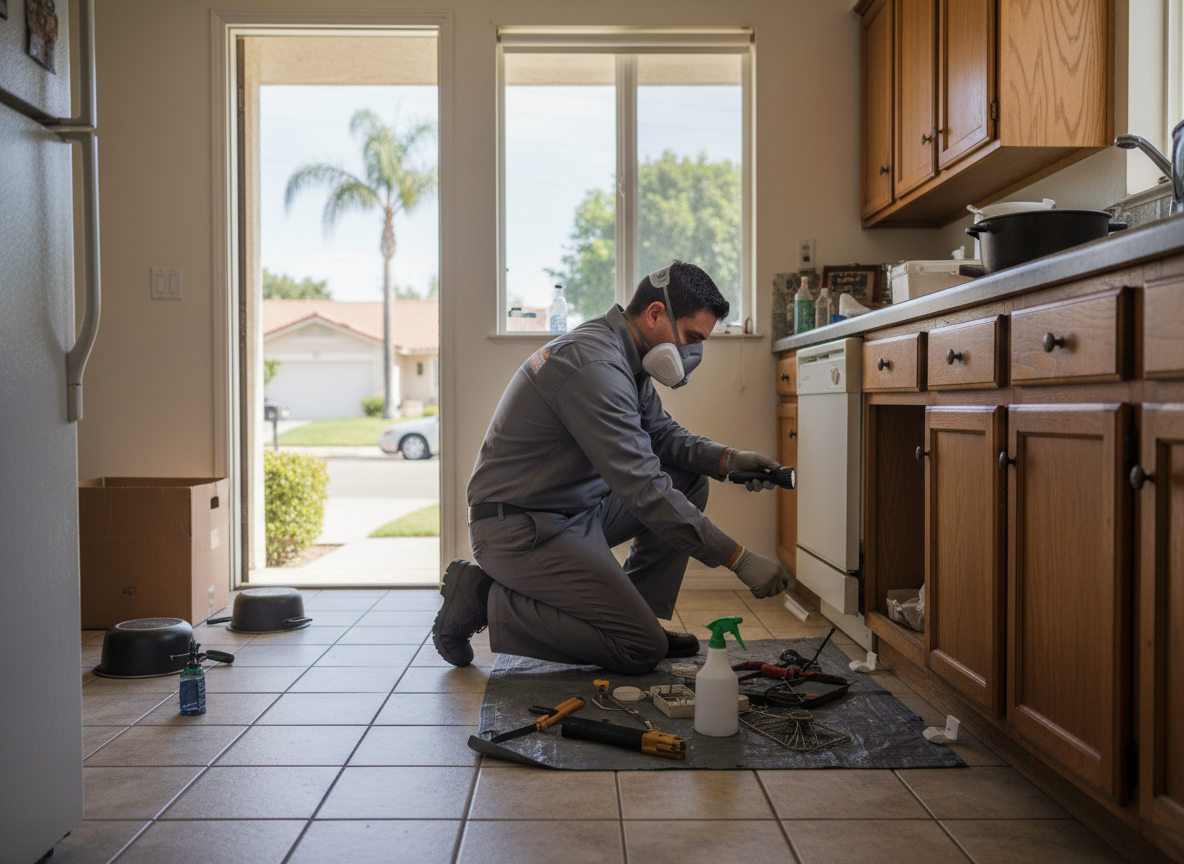
A mice exterminator solving a house mouse (Mus musculus) problem is running a different program from a rat exterminator, and the two differences are density and tolerance. Density, because a house mouse ranges only a few feet from its nest, which means devices have to be placed close together and close to the harborage rather than spread across a room the way rat devices are spread along travel routes. Tolerance, because mouse exclusion must close every gap wider than a quarter inch, roughly a pencil width, where rat exclusion works to a half-inch standard. A building that has been rat-proofed is regularly still open to mice.
Structural rodent work in California requires a Structural Pest Control Board license, Branch 2, and any pesticide application must follow California Department of Pesticide Regulation labeling. That matters here because effective mouse extermination is mostly building work: sealing plumbing and gas penetrations behind cabinetry, closing toe kick gaps, fitting metal-backed garage door seals and packing utility openings with copper mesh. An operator offering mouse proofing without that license is doing construction on your building envelope without the credential the state requires for it.
The program has to be scheduled against the breeding rate rather than against a fixed visit count. A female house mouse reaches sexual maturity in around six weeks and can produce five to ten litters a year of five to six young each. This is why a mouse program that stops after two visits fails: the trapping knocks down the adults present, and the next cohort matures into the same unsealed structure a month later. A competent mice exterminator schedules checks through that cycle and treats the sanitation and exclusion as the components that limit how far the population can rebuild between visits.
No rodenticide belongs in a kitchen or food preparation area, and in California AB 1788, the California Ecosystems Protection Act, has independently placed a statewide moratorium on most uses of second-generation anticoagulant rodenticides including brodifacoum, bromadiolone, difethialone and difenacoum. Interior control is mechanical only: snap traps set flush against wall and cabinet runways with the trigger toward the wall, and enclosed or tamper-resistant devices inside cabinets where children or pets may reach. Beyond the compliance question, a poisoned mouse dies inside a cabinet void or an appliance cavity and produces decomposition odor in the room the food is prepared in.
The most common reason a mouse program fails is that the exterminator treats the kitchen. Mice appear in the kitchen because that is where the food is; the colony is usually based in the attached garage behind stacked cardboard, in the crawl space, in the attic or in a wall void, travelling in through unsealed plumbing and gas penetrations, refrigerator and dishwasher water line entries, toe kick gaps and openings around electrical boxes. A real program traces the route backward, treats the source in parallel with the destination, seals to a quarter inch with copper mesh and hardware cloth rather than foam, and finishes with wet droppings removal and enzymatic treatment of the urine trails that mark the route as established.
Technician insight
The way to tell whether a mice exterminator knows the job is to watch where they go first. If they set traps in the kitchen and leave, you will be calling them again in six weeks. If they pull the refrigerator forward, follow the wall void, and end up in your garage looking at the door seal and the stack of cardboard boxes, they understand that the kitchen is the destination and not the address. The other thing is device count. Mice do not commute the way rats do, so a handful of traps spread across a room is the wrong shape of program. You want a lot of devices packed tight against the runways near the nest, and you want the quarter-inch gaps closed with copper mesh so the population outside stops replacing what you catch inside.
Cafe failing on droppings despite a monthly bait program
A cafe owner had been through two pest companies in a year. Both had run monthly visits with bait stations in the back-of-house, and mouse droppings kept appearing in the dry storage room ahead of health inspections. Two things were wrong. First, bait was the wrong tool: it was inappropriate in a food premises and it was producing dead mice inside the wall cavities. Second, nobody had traced the source. The colony was based behind a stack of pallets in the shared rear corridor, entering the dry store through an unsealed conduit penetration and a gap at the base of the demising wall, both around half an inch. The program switched interior devices to mechanical multi-catch and snap traps at high density along the storage shelving runways, treated the corridor harborage in parallel, packed both penetrations with copper mesh and sealed them with sheet metal, and fitted a metal-backed sweep to the rear service door. Droppings were removed wet with food-safe disinfection and the shelving treated enzymatically. Activity dropped to zero across the following two service visits and the site passed its next inspection with a clean device log.
Mice Exterminator Services We Offer
✓Kitchen and Pantry Mouse Extermination
Food-safe mechanical extermination in kitchens, pantries, cabinet voids and appliance housings, with no rodenticide in food preparation areas.
✓Source Harborage Treatment
Treatment of the garage, crawl space, attic or wall void where the colony is actually based, run in parallel with the area where droppings appear.
✓Quarter-Inch Mouse Proofing
Sealing every gap wider than a quarter inch with copper mesh, hardware cloth and sheet metal, tighter than the half-inch tolerance rat work uses.
✓Commercial Mouse IPM Programs
Multi-catch and snap device programs for restaurants, cafes and food premises, with numbered device maps and service logs for health inspections.
✓Appliance Void Nest Extraction
Removal of nests from refrigerator compressor compartments, dishwasher cavities and range voids, with gnaw damage to wiring and water lines documented.
✓Decontamination and Pheromone Treatment
Wet droppings removal with food-safe disinfection, plus enzymatic treatment of the urine trails that mark routes as established and draw new mice back.
Mice Exterminator Cost in California
| Service | Typical Range | What Affects It |
|---|---|---|
| Licensed inspection and source tracing | $125-$250 | Includes pulling kitchen appliances forward and identifying the upstream harborage |
| Mice extermination program | $200-$500 | Higher device count across more return visits than rat work, scheduled against the breeding cycle |
| Upstream source treatment | $300-$900 | Garage, crawl space or attic trapping where the colony is actually based |
| Quarter-inch exclusion sealing | $350-$1,200 | Copper mesh, hardware cloth and metal-backed door seals; by penetration count and cabinet access |
| Decontamination and enzymatic treatment | $250-$700 | Wet droppings removal, food-safe disinfection and pheromone trail treatment |
| Commercial mouse IPM program | $150-$450 per visit | Multi-catch device map, scheduled monitoring and audit documentation |
Ranges are typical for California and confirmed with an exact written quote before any work starts.
How it works
- 1
Licensed Inspection and Identification
A licensed technician confirms house mouse from dropping size and pointed ends, maps contaminated areas, and pulls kitchen appliances forward rather than inspecting from the front.
- 2
Source Tracing
The route is traced backward from where droppings appear to the actual harborage in the garage, crawl space, attic or wall void, because treating the destination alone does not clear a colony.
- 3
High-Density Mechanical Trapping
Snap traps set flush against wall and cabinet runways with the trigger toward the wall, placed at high density close to the harborage. Enclosed devices inside cabinets and anywhere children or pets are present. No rodenticide in food areas.
- 4
Scheduled Checks Against the Breeding Cycle
Checks are scheduled to work through the breeding cycle rather than stopping at the first quiet week, since a female mouse can produce five to ten litters a year and the next cohort matures in about six weeks.
- 5
Quarter-Inch Exclusion Sealing
Every gap wider than a quarter inch packed with copper mesh and sealed, or covered with hardware cloth and sheet metal: plumbing and gas penetrations, appliance water lines, toe kick gaps, electrical boxes and garage door seals.
- 6
Decontamination and Sanitation Plan
Droppings and nesting material pre-misted and removed wet, contact surfaces disinfected food-safe, urine trails treated enzymatically, and a written storage and sanitation plan provided.
Pricing
Mouse extermination cost is set by infestation level, penetration count and whether an upstream source area also needs treatment. Written quote after inspection, Mon-Fri 8am-6pm and Sat 9am-2pm.