Kitchen rodent activity is usually house mice (Mus musculus) rather than rats, and it is almost never where the problem starts. The kitchen is where the evidence appears, because it holds the food, but the population typically originates in the garage, the crawl space, the attic or a wall void and works inward. This distinction matters because trapping in the kitchen alone catches mice indefinitely without ever resolving the situation. A proper kitchen job traces the route backward to the source and treats there as well.
The entry points into a kitchen are consistent and mostly hidden behind cabinetry. The plumbing penetration under the sink where supply lines and the drain pass through the wall or floor is the single most common. Beyond that: gas line penetrations behind the range, dishwasher supply and drain penetrations, refrigerator water line entries, unsealed openings around electrical boxes, gaps at the toe kick where base cabinets meet the floor, and the void behind and beneath a drop-in range. Cabinet interiors, particularly the dead corner of a lazy susan and the space above upper cabinets, provide the undisturbed harborage.
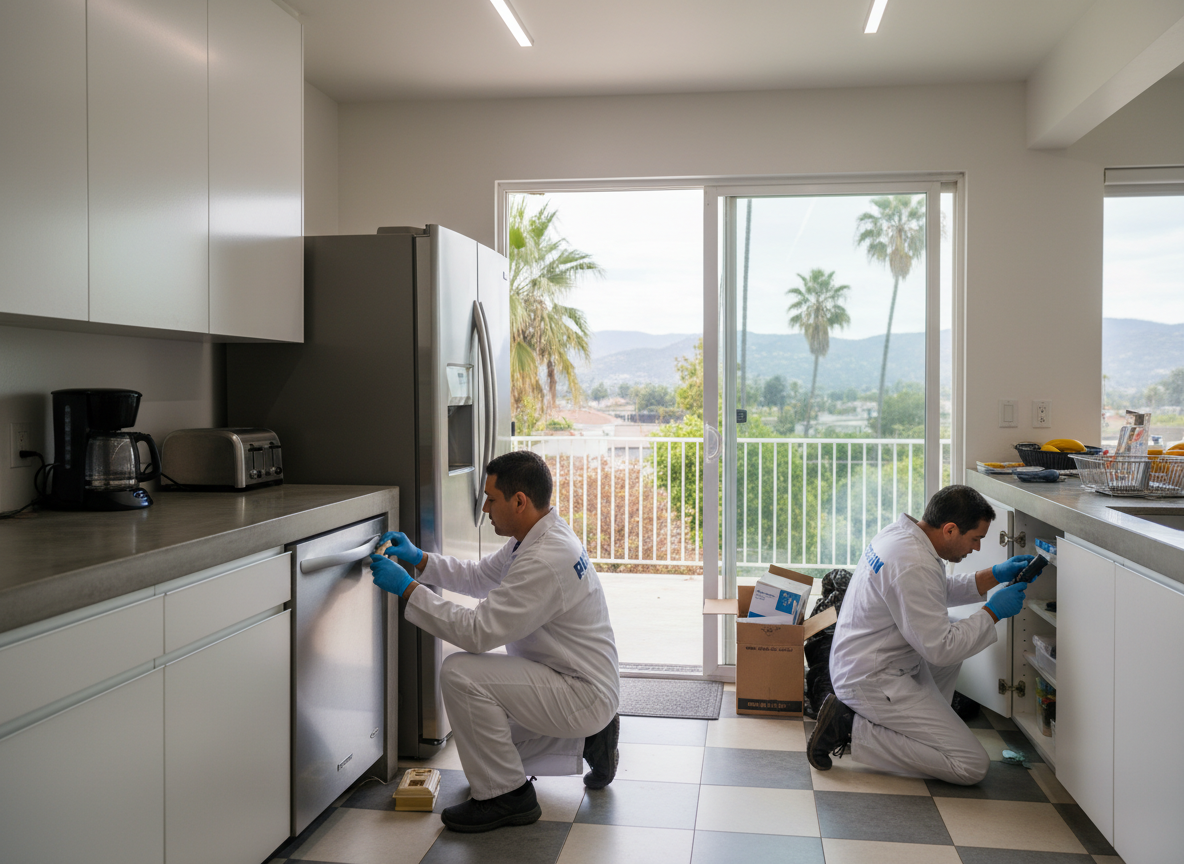
Appliances are habitat rather than obstacles. The compressor compartment beneath a refrigerator is warm, dark, undisturbed and often has crumb debris beneath it, which makes it a preferred nesting location. The insulated cavity of a dishwasher and the void beneath a slide-in range serve the same purpose. Rodents nesting in these spaces gnaw wiring and water lines, and a mouse nest built into an appliance's electrical compartment is a real fire and flood risk. Any kitchen inspection that does not involve pulling the appliances forward is incomplete.
Treatment in a kitchen has to be food-safe, which constrains the toolkit in a way that is genuinely appropriate rather than merely cautious. No rodenticide is placed in a food preparation area under any circumstances, both because of contamination risk and because a poisoned mouse dying inside a cabinet void or appliance cavity creates an odor problem in the room you eat in. Control is mechanical only: snap traps set flush against wall and cabinet runways with the trigger toward the wall, and enclosed devices inside cabinets where children or pets may reach. This aligns with California Retail Food Code expectations for commercial kitchens and is simply the correct standard for domestic ones.
Sanitation and food storage determine whether the result holds. Dry goods including flour, rice, pasta, cereal, sugar and pet food move into sealed glass or hard plastic containers, since mice chew through cardboard boxes and bagged packaging without difficulty. Crumb management extends to under and behind appliances, not just visible counters. Waste goes into a lidded container and is emptied nightly, produce comes off open counters, and pet food bowls are not left down overnight. In a kitchen these controls carry more weight than the device program, because they remove the reason the rodents came in.
Technician insight
If you are catching mice in your kitchen week after week and the catches never taper off, you do not have a kitchen problem. You have a garage problem, or a crawl space problem, or an attic problem, and the kitchen is simply where they come to eat. That is the single most common pattern I see, and it is why kitchen-only trapping frustrates people for months. The other thing worth saying is that nobody should be putting bait in a kitchen. Aside from the contamination issue, a mouse that eats bait goes back into the cabinet void or the space under the dishwasher to die, and now you have decomposition odor in the room where you prepare food. Traps, placed flush against the wall with the trigger toward it, and then seal the hole under the sink.
Nest in a refrigerator compressor compartment
The homeowner reported droppings appearing in the lower kitchen cabinets over about three weeks, along with an intermittent electrical smell they could not place. Front-of-cabinet inspection showed droppings but no obvious entry. Pulling the refrigerator forward revealed the actual situation: an established mouse nest in the compressor compartment built from shredded insulation and cardboard, heavy droppings on the coil housing, and gnaw damage to the compressor wiring loom which explained the smell. The entry into the kitchen was the gap around the refrigerator water line penetration, roughly half an inch, connecting to the wall void. Tracing that void led back to the attached garage, where the door bottom seal had failed. Snap traps were set flush along the cabinet toe kick and behind the appliance, the garage was trapped and its door seal replaced in parallel, the water line penetration and two under-sink penetrations were packed with copper mesh and sealed, the compressor compartment was cleaned and disinfected, and the damaged wiring was referred to an appliance technician. Activity stopped in ten days.
Kitchen Rodent Control Services We Offer
✓Cabinet and Pantry Rodent Removal
Trapping and removal from base and upper cabinet voids, pantry shelving and lazy susan dead corners, with food-safe mechanical devices only.
✓Appliance Void Inspection and Treatment
Pulling refrigerators, ranges and dishwashers forward to inspect compressor compartments, insulated cavities and undersides for nesting and gnaw damage.
✓Plumbing and Gas Penetration Sealing
Sealing the under-sink, dishwasher, refrigerator water line and gas line penetrations that account for the majority of kitchen entries.
✓Toe Kick and Cabinet Base Sealing
Closing gaps where base cabinets meet the floor and the voids behind toe kicks that connect cabinet runs to wall cavities.
✓Source Tracing and Upstream Treatment
Tracing the route back to the originating population in the garage, crawl space, attic or wall void, so kitchen trapping is not treating the symptom alone.
✓Food-Safe Sanitation Plan
Written guidance on sealed dry goods storage, crumb control under appliances, waste handling and pet food management.
✓Kitchen Decontamination
Wet removal of droppings from shelving, drawer interiors and appliance voids with food-safe disinfection of all contact surfaces.
Kitchen Rodent Control Cost in California
| Service | Typical Range | What Affects It |
|---|---|---|
| Kitchen inspection with appliance pull | $125-$250 | Typically credited toward the work when it proceeds |
| Trapping and removal | $200-$500 | Mice usually require more return checks than rats due to breeding rate |
| Penetration and toe kick sealing | $250-$700 | Driven by number of penetrations and cabinet access difficulty |
| Upstream source treatment | $300-$900 | Garage, crawl space or attic work where the population originates |
| Kitchen decontamination | $250-$600 | Cabinet, shelving and appliance void cleaning with food-safe disinfection |
Ranges are typical for California and confirmed with an exact written quote before any work starts.
How it works
- 1
Kitchen Inspection Including Appliances
Full inspection of cabinet interiors and voids, pantry, under-sink area and behind and beneath refrigerator, range and dishwasher. Appliances are pulled forward, not inspected from the front.
- 2
Entry Point and Route Identification
Every penetration is located: plumbing, gas, dishwasher, refrigerator water line, electrical boxes, toe kick gaps and cabinet-to-wall voids, plus the route back to the source population.
- 3
Mechanical Trapping
Snap traps set flush against wall and cabinet runways with the trigger facing the wall, and enclosed devices inside cabinets. No rodenticide in a food preparation area.
- 4
Upstream Source Treatment
The originating area, typically garage, crawl space, attic or wall void, is treated in parallel, since kitchen-only trapping does not resolve an upstream population.
- 5
Exclusion Sealing
Penetrations packed with copper mesh and sealed, toe kick gaps closed, and cabinet-to-wall voids blocked with sheet metal where they connect to the wider structure.
- 6
Decontamination and Sanitation Plan
Droppings removed wet after disinfectant pre-misting, contact surfaces disinfected food-safe, and a written storage and sanitation plan provided.
Pricing
Cost depends on infestation level, how many penetrations require sealing and whether an upstream source area also needs treatment. Written quote after inspection, Mon-Fri 8am-6pm and Sat 9am-2pm.