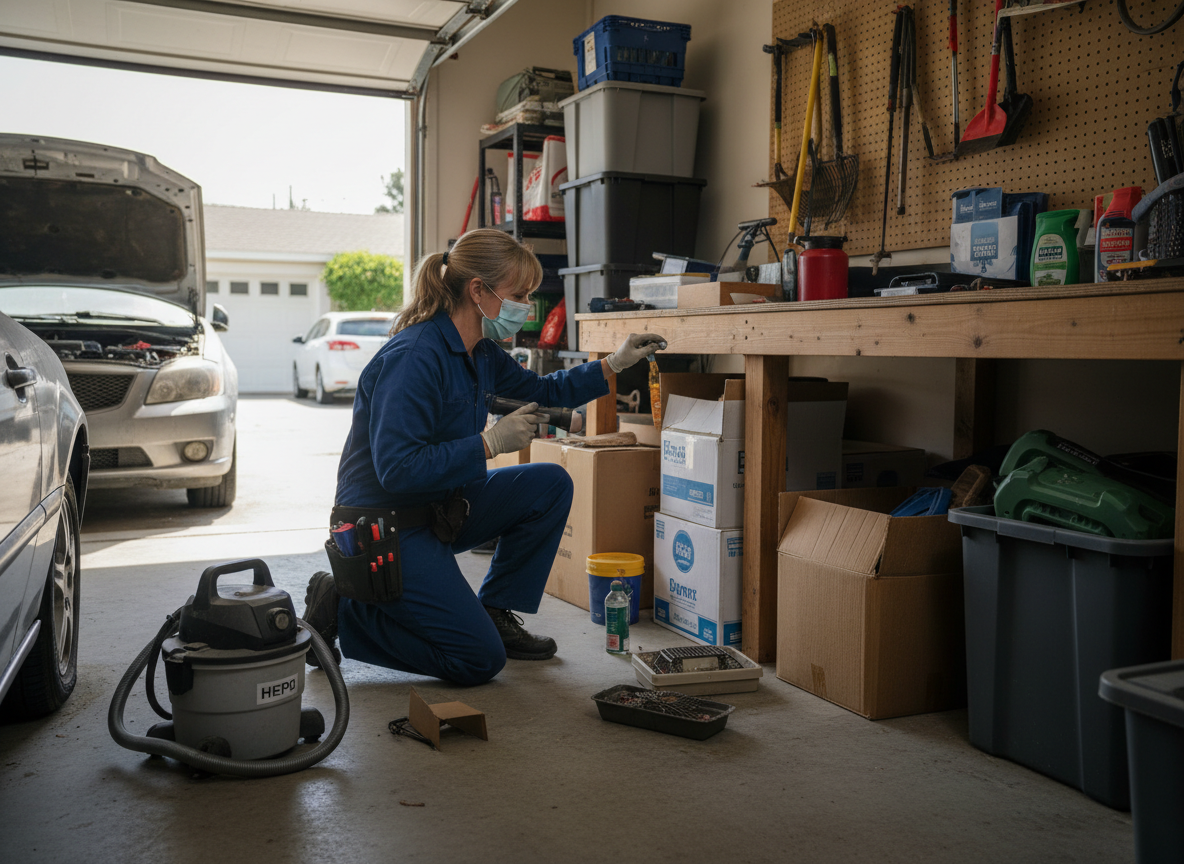
The garage is where most residential rodent infestations begin, and the reason is the door. A sectional garage door is the single largest opening in a typical California home, and its bottom seal is a wearing part. Once the rubber astragal hardens, cracks or compresses out of shape, or the concrete slab has settled unevenly beneath it, the resulting gap is easily passable. The corners are the worst offenders, since the seal rarely conforms tightly where the door meets the jamb. A quarter-inch gap admits a house mouse and half an inch admits a young rat, and those tolerances are met by almost any worn seal.
Once inside, garages provide unusually good habitat. Stored cardboard boxes are simultaneously shelter and nesting material. Pet food, bird seed, grass seed and fertilizer stored in bags rather than sealed containers are a concentrated food source. Recycling bins hold residue. Water heaters and utility areas provide warmth and often a small water source. Seldom-moved stored items, holiday decorations, camping equipment and boxes stacked against walls give undisturbed harborage. In effect the garage becomes a staging area where a population establishes and then works inward through the shared wall into kitchen cabinetry, pantry and wall voids.
Vehicle damage is the consequence homeowners are least prepared for. Rodents nest in engine bays for the retained warmth and gnaw wiring harnesses, and it is worth knowing that many manufacturers moved to soy-based and other bio-derived wire insulation, which rodents find more palatable than the older petroleum-based formulations. Damaged harnesses cause intermittent electrical faults that are expensive and difficult to diagnose, and comprehensive auto insurance treatment of rodent damage varies by carrier. Nesting material packed into a cabin air filter housing or on top of an engine block is also a genuine fire risk.
Exclusion for a garage centers on the door hardware. A metal-backed bottom seal, correctly sized to the actual gap and fitted to a level threshold, is the primary fix, with a threshold seal added where the slab has settled. Side and top weatherstripping is checked and replaced where compressed. Beyond the door: the pedestrian side door gets a sweep, wall-to-slab junctions are sealed, utility and conduit penetrations are packed with copper mesh, and any gap where the garage wall meets the house structure is closed so the shared wall stops being a route inward.
Sanitation correction is what keeps a garage clear afterward. Pet food, bird seed and grass seed move into sealed metal or heavy plastic containers rather than original bags. Cardboard storage is replaced with sealed plastic bins, which removes both the shelter and the nesting material in one step. Items are shifted off the floor onto shelving with a clear inspection gap at the wall. Recycling gets rinsed and lidded. These are not incidental suggestions; in a garage they are usually the difference between a treatment that holds and one that has to be repeated.
Technician insight
Nearly every home rodent problem I inspect has a garage component, and nearly every one of them has a garage door seal that stopped sealing years ago. People check the middle of the door where it looks fine and never check the corners, which is where the gap almost always is. The second thing is stored cardboard. A garage full of cardboard boxes is a garage full of nesting material with shelter already built in, and swapping to sealed plastic bins removes both problems at once for less than most people expect. Third, if you keep pet food or bird seed in the garage in the original bag, that is the reason the population is sustaining itself. Sealed metal or heavy plastic containers, every time.
Mice in the kitchen traced back to the attached garage
The homeowner's complaint was mice in the kitchen: droppings in the lower cabinets and behind the range. Trapping in the kitchen caught steadily without ever getting ahead, which is the signature of an upstream population rather than an isolated one. The garage survey found the actual source. The sectional door seal had hardened and pulled away at both corners, leaving gaps of roughly three quarters of an inch. Inside, a forty pound bag of dog food sat open on the floor, around twenty cardboard storage boxes were stacked directly against the shared wall, and there was heavy droppings accumulation behind them with a nest in one box. The route into the kitchen was an unsealed gap around the plumbing penetration in the shared wall behind the sink cabinet. Work involved trapping in the garage rather than only the kitchen, fitting a metal-backed bottom seal and threshold, sealing the shared wall penetration with copper mesh, removing the contaminated boxes and cleaning the area, and the owner moved the dog food to a sealed container and switched to plastic bins. Kitchen activity stopped in eight days.
Garage Rodent Control Services We Offer
✓Garage Door Seal Exclusion
Fitting metal-backed bottom seals sized to the actual gap, plus threshold seals where the slab has settled, and replacing compressed side and top weatherstripping.
✓Vehicle Wiring Protection
Inspection of engine bays and cabin air filter housings for nesting and gnaw damage, with device placement and deterrent measures around parked vehicles.
✓Stored Item and Sanitation Correction
Converting cardboard storage to sealed bins, moving pet food and seed into sealed containers, and establishing floor clearance and wall inspection gaps.
✓Attached Garage Wall Sealing
Closing the penetrations and junctions where the garage meets the house structure, so the shared wall stops functioning as a route into living space.
✓Detached Garage and Outbuilding Proofing
Full exclusion for detached garages, workshops and sheds, which typically have more grade-level gaps and less frequent inspection than attached structures.
✓Garage Trapping and Cleanup
Snap trap placement along wall runways and behind stored items, plus droppings removal with disinfection and ectoparasite treatment.
Garage Rodent Control Cost in California
| Service | Typical Range | What Affects It |
|---|---|---|
| Garage inspection and survey | $125-$225 | Typically credited toward the work when it proceeds |
| Trapping and removal | $200-$500 | Based on infestation level and number of scheduled checks |
| Garage door seal and threshold | $150-$450 | Metal-backed bottom seal plus threshold where the slab has settled; wider doors sit higher |
| Structural exclusion | $300-$900 | Wall-to-slab junctions, utility penetrations, pedestrian door and shared wall sealing |
| Cleanup and disinfection | $250-$700 | Droppings removal, disinfection and ectoparasite treatment, priced by area |
| Detached garage full proofing | $600-$1,600 | Typically more grade-level entry points than an attached structure |
Ranges are typical for California and confirmed with an exact written quote before any work starts.
How it works
- 1
Garage and Door Survey
Measurement of the actual door gap along its full width including corners, inspection of side and top weatherstripping, pedestrian door, wall-to-slab junction and all utility penetrations.
- 2
Harborage and Attractant Audit
Assessment of stored items, cardboard, pet food, seed, fertilizer and recycling, plus identification of nesting sites behind and inside seldom-moved storage.
- 3
Vehicle Inspection
Check of engine bays and cabin air filter housings for nesting material and gnaw damage to wiring harnesses, documented for the owner.
- 4
Trapping
Snap traps set along wall runways, behind stored items and at confirmed travel paths, checked on a set schedule until activity stops.
- 5
Door and Structural Exclusion
Metal-backed bottom seal and threshold fitted, weatherstripping replaced, pedestrian door swept, wall-to-slab junctions and utility penetrations sealed with copper mesh and sheet metal.
- 6
Cleanup and Sanitation Plan
Droppings removed wet with disinfection, ectoparasites treated, and a written storage and sanitation plan provided covering containers, shelving and floor clearance.
Pricing
Cost depends on door condition, garage size, stored item volume and how much structural sealing is required. Written quote after survey, Mon-Fri 8am-6pm and Sat 9am-2pm.