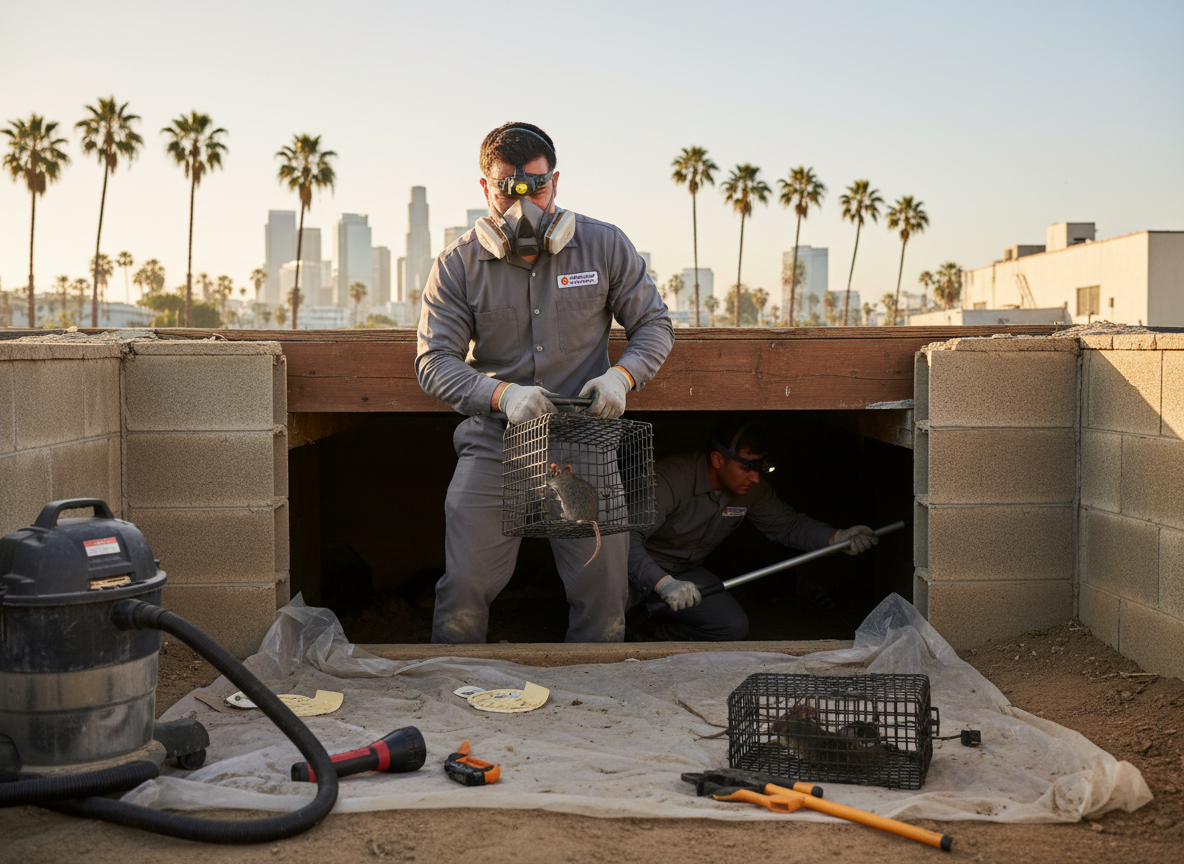
Crawl space infestations are typically Norway rats (Rattus norvegicus) rather than roof rats. Norway rats are ground dwelling burrowers, heavier bodied and less inclined to climb, and they reach the subfloor through openings at grade: unscreened or damaged foundation vents, crawl space access panels that no longer sit flush, gaps at the siding-to-foundation junction, foundation cracks, utility trenches and sewer laterals. Once under the floor they burrow into the substrate, nest in the underfloor insulation, and travel the joist bays, which is what produces scratching heard through the floor rather than the ceiling.
The crawl space offers rodents everything they need, which is why infestations there persist. It is dark, undisturbed, thermally stable, and in most California homes it contains a moisture source: a weeping plumbing connection, condensation on ductwork, poor drainage against the foundation, or irrigation overspray soaking the perimeter soil. Water is the limiting factor for rodents through California's long dry summer, so a crawl space with a moisture problem is far more attractive than a dry one. Correcting the moisture is often as important as the trapping.
Structural damage under the floor tends to be discovered late because nobody goes down there. The recurring findings are torn or displaced vapor barrier, underfloor batt insulation pulled down and used as nesting material, chewed HVAC flex duct which then pulls contaminated crawl space air directly into the living space through the return, gnawed plumbing supply lines, damaged electrical, and burrow networks in the substrate that can undermine footings where they run against a foundation. Damaged ductwork is the finding that most directly affects indoor air quality upstairs.
Removal follows the same order as any structural rodent job. Snap traps go on the confirmed joist bay runways and along the burrow entrances. Once consecutive checks show zero activity, the exclusion proceeds: foundation vents screened with 1/4 inch galvanized hardware cloth, access panels refitted with proper seals and latches, foundation cracks sealed with mortar, siding junctions closed with sheet metal, and utility penetrations packed with copper mesh and sealed. Sealing before the space is clear traps rodents beneath the floor, and a Norway rat dying under a subfloor produces four to six weeks of odor venting up through the floor system.
Decontamination in a crawl space differs from attic work in one key respect: the contamination sits on and in the vapor barrier and the ground beneath it. Contaminated barrier is removed and replaced rather than cleaned, since it is neither practical nor reliable to disinfect sheeting that has held droppings and urine. The ground surface is treated, nesting material and droppings are removed wet after disinfectant pre-misting rather than dry swept, and ectoparasite treatment is applied because fleas and rat mites persist in the substrate long after the rodents are gone and will migrate up into living space seeking a new host.
Technician insight
The crawl space finding that matters most and gets noticed least is chewed HVAC duct. Rodents gnaw flex duct, the system then pulls air from the crawl space through the damaged return, and everything down there including dried droppings, urine residue and mite activity goes straight into the air upstairs. People report a musty smell they attribute to the house being old, and they are actually smelling the crawl space through their own ventilation system. The other point is moisture. Through a California summer the crawl space is often the only reliable water source on the property, which is why a weeping plumbing joint or irrigation soaking the perimeter matters more than most people expect. Fix that and the space becomes far less worth colonizing.
Musty smell upstairs traced to a crawl space rat colony
The occupants reported a persistent musty odor on the ground floor that worsened when the air conditioning ran, plus intermittent scratching heard through the floor in the evenings. The crawl entry found an established Norway rat presence: four burrow openings in the substrate, two of them against the foundation footing, underfloor batt insulation pulled down across roughly three joist bays for nesting, vapor barrier torn and displaced over most of the crawl, and a section of HVAC flex duct with a chewed opening about four inches long. That damaged return was pulling crawl space air directly into the living space, which explained why the smell tracked with the AC running. The entry point was a foundation vent with rusted-through screening plus an access panel that had warped and no longer sealed. Trapping ran twelve days at the burrow entrances and joist bay runways. The vent was rescreened with 1/4 inch galvanized hardware cloth, the access panel replaced and properly latched, and two foundation cracks mortared. Contaminated vapor barrier and insulation were removed, the ground treated, mites treated, new barrier installed, and the duct section repaired by an HVAC contractor. The odor upstairs cleared within a week.
Crawl Space Rodent Removal Services We Offer
✓Norway Rat Burrow Treatment
Locating and treating burrow networks in the crawl space substrate and against foundation footings, with trapping at active burrow entrances.
✓Foundation Vent Screening
Screening every foundation and crawl space vent with 1/4 inch galvanized hardware cloth while maintaining required ventilation area.
✓Access Panel and Door Sealing
Refitting crawl space access panels and doors with proper seals and latches, one of the most common entry points found in California homes.
✓Vapor Barrier Replacement
Removal of contaminated and rodent-damaged vapor barrier and installation of new sheeting, since contaminated barrier cannot be reliably cleaned.
✓Underfloor Insulation and Duct Assessment
Identifying insulation pulled down for nesting and chewed HVAC flex duct, which pulls contaminated crawl space air into the living space through the return.
✓Moisture Source Correction
Identifying weeping plumbing, duct condensation, drainage and irrigation overspray that make the crawl space attractive through California's dry season.
✓Subfloor Decontamination
Wet removal of droppings and nesting material with disinfection, ground treatment and ectoparasite treatment for fleas and rat mites in the substrate.
Crawl Space Rodent Removal Cost in California
| Service | Typical Range | What Affects It |
|---|---|---|
| Crawl space inspection and survey | $150-$325 | Higher for low-clearance crawls or restricted access points |
| Trapping and burrow treatment | $300-$700 | Based on burrow count, infestation level and number of scheduled checks |
| Vent screening and perimeter exclusion | $400-$1,200 | Driven by vent count, foundation condition and access panel work required |
| Droppings and nesting removal with disinfection | $500-$1,500 | Priced by contaminated area and clearance height |
| Vapor barrier replacement | $0.75-$2.00 per sq ft | Higher in low-clearance crawls where working conditions restrict progress |
| Underfloor insulation replacement | $1.75-$3.50 per sq ft | Where nesting has compressed or contaminated existing batts |
| Ectoparasite treatment | $200-$500 | Fleas and rat mites persisting in substrate after removal |
Ranges are typical for California and confirmed with an exact written quote before any work starts.
How it works
- 1
Crawl Space Entry and Survey
Full crawl entry to map burrow openings, joist bay runways, droppings, nesting sites, damaged vapor barrier, chewed duct and insulation, and any moisture source present.
- 2
Perimeter Entry Point Survey
Exterior survey of foundation vents, access panels, siding-to-foundation junctions, foundation cracks and utility penetrations at grade.
- 3
Trapping at Burrows and Runways
Snap traps set at active burrow entrances and along confirmed joist bay travel paths, checked on a set schedule until consecutive checks show zero activity.
- 4
Exclusion Sealing
Only once the space is clear: vents screened with 1/4 inch hardware cloth, access panels resealed, foundation cracks mortared, siding junctions closed and utility penetrations packed and sealed.
- 5
Contaminated Material Removal
Droppings and nesting material pre-misted with disinfectant and removed wet. Contaminated vapor barrier and nest-matted underfloor insulation removed rather than cleaned.
- 6
Restoration and Moisture Correction
New vapor barrier installed, ground treated, ectoparasites treated, and moisture sources documented for correction so the space stops being attractive.
Pricing
Cost depends on crawl height and access, infestation level, vapor barrier area and how much duct or insulation damage is present. Written quote after survey, Mon-Fri 8am-6pm and Sat 9am-2pm.