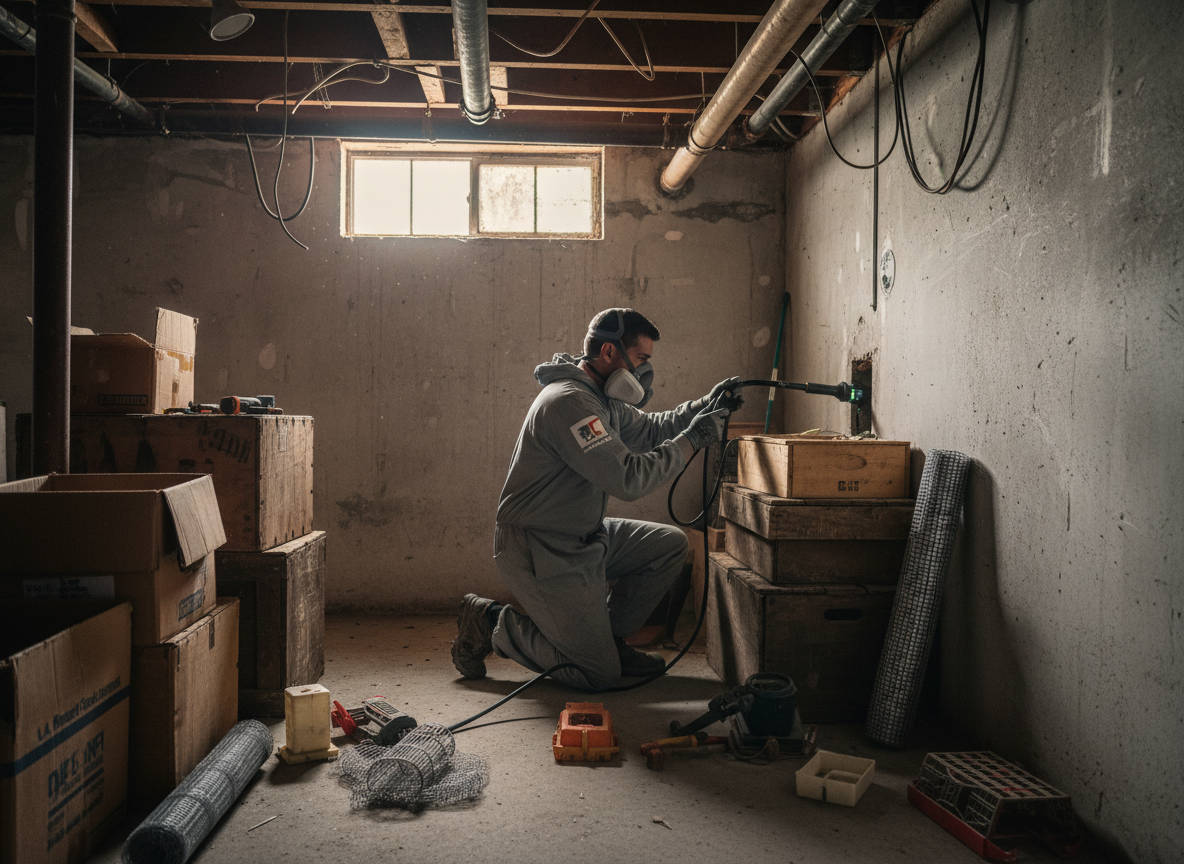
Basements are less common in California than in most of the country, since the prevailing residential construction is slab-on-grade or raised foundation with a crawl space. Where basements do exist, typically in older housing stock, in hillside builds with daylight or walkout lower levels, and in commercial and multi-family buildings, they present a distinct rodent problem. The species is almost always Norway rats (Rattus norvegicus) or house mice (Mus musculus), since roof rats favor the attic. Norway rats are strong swimmers and burrowers that reach below-grade space through routes an above-ground inspection never considers.
Floor drains and sewer connections are the entry route people find hardest to accept. Norway rats travel municipal sewer lines and can enter a building through a floor drain with a missing, cracked or improperly seated grate, or through a broken or unsealed cleanout. A dry floor drain trap is a particular vulnerability, because the water seal that would otherwise block passage evaporates in unused drains. Sump pits with unsealed lids, unsealed sump discharge lines and abandoned or damaged drain lines are variations on the same pathway.
Above the drain line the recurring entries are window wells and utility penetrations. Basement window wells collect leaf litter and debris that provides cover, and the windows themselves are frequently old, poorly fitted or left ajar for ventilation. Utility penetrations for water service, gas, electrical, telecom and irrigation pass through the foundation wall and are commonly sealed with nothing more than mortar that has cracked, or foam that has been chewed. Foundation cracks in older masonry and gaps at the rim joist complete the picture. Walkout and daylight basements add door thresholds to the list.
Moisture is what turns a basement from passable to attractive. Below-grade space in California frequently has some combination of hydrostatic seepage, condensation on cold water lines, a leaking water heater or laundry connection, or poor exterior drainage directing water against the foundation. Since water is the limiting resource for rodents through the long dry season, a damp basement offers what the rest of the property does not. Moisture correction is treated as part of the rodent work rather than a separate building issue, because without it the space stays attractive no matter how well it is sealed.
Treatment order is the same as any structural job and matters more in a basement because of the drain pathway. Trapping runs first along wall runways, behind stored items and near suspected entry points until consecutive checks show zero activity. Exclusion follows: floor drains fitted with proper metal grates or backflow devices, sump lids sealed, window wells screened and cleared of debris, utility penetrations packed with copper mesh and sealed with mortar or sheet metal, foundation cracks repaired and rim joist gaps closed. Sealing before the space is clear traps rodents in the wall system, and cleanup follows the same wet removal and disinfection protocol as any other rodent contaminated area.
Technician insight
The thing people refuse to believe about basements is the floor drain. Norway rats swim, they use sewer lines as travel corridors, and a floor drain with a cracked grate or a trap that has dried out is an open door that nobody thinks to check because it is in the floor. If you have activity in a below-grade space and no visible entry point above ground, that is the first thing to inspect. The second is the window well, mostly because it accumulates leaf litter that provides perfect cover while the window itself is often the oldest and worst-fitted opening in the building. And in a California basement, moisture is doing more work than most people credit. Water is scarce here for most of the year, so a damp basement is genuinely valuable habitat.
Activity in a below-grade utility room with no visible entry
A multi-family building had persistent rat activity in a below-grade utility and laundry room. Two prior treatments had been trapping only and the activity had returned each time within a month. The full above-grade exterior survey found nothing that explained it. The below-grade survey found two things. The floor drain in the laundry area had a cracked cast grate with a section missing entirely, and the trap beneath it had dried out because the drain had not received water in months once the old utility sink was removed. There was also an unsealed penetration where the water service entered the foundation wall, with cracked mortar around it. Norway rats were entering through the sewer line via the dry drain. The fix involved trapping until the space was clear, fitting a proper metal grate with a backflow device, restoring a water seal to the trap, packing and sealing the water service penetration with copper mesh and mortar, and sealing a further two foundation cracks. The building manager also arranged for periodic water into the drain to maintain the trap seal. No recurrence.
Basement Rodent Control Services We Offer
✓Floor Drain and Sewer Line Exclusion
Fitting proper metal grates or backflow devices to floor drains, sealing cleanouts, and addressing dry traps that have lost their water seal and allow passage.
✓Sump Pit and Discharge Sealing
Sealing sump pit lids and discharge line penetrations, a frequently overlooked below-grade entry route.
✓Window Well Screening and Clearing
Screening basement window wells, clearing accumulated leaf litter and debris that provides cover, and addressing poorly fitted or damaged windows.
✓Utility Penetration Sealing
Closing water, gas, electrical, telecom and irrigation penetrations through the foundation wall with copper mesh, mortar and sheet metal collars.
✓Foundation Crack and Rim Joist Repair
Sealing masonry cracks and closing gaps at the rim joist where the foundation meets the framing, common in older construction.
✓Moisture Source Correction
Identifying seepage, pipe condensation, appliance leaks and exterior drainage issues that make below-grade space attractive through the dry season.
✓Basement Trapping and Decontamination
Snap trap placement along wall runways and behind storage, plus wet droppings removal with disinfection and ectoparasite treatment.
Basement Rodent Control Cost in California
| Service | Typical Range | What Affects It |
|---|---|---|
| Basement inspection and survey | $150-$300 | Typically credited toward the work when it proceeds |
| Trapping and removal | $250-$600 | Based on infestation level and number of scheduled checks |
| Drain and sump exclusion | $200-$650 | Grates, backflow devices, cleanout sealing and sump lid work |
| Window well and penetration sealing | $300-$900 | Driven by well count, window condition and number of utility penetrations |
| Foundation crack and rim joist sealing | $300-$1,100 | Older masonry foundations with multiple cracks sit at the higher end |
| Cleanup and disinfection | $300-$900 | Droppings removal, disinfection and ectoparasite treatment, priced by area |
Ranges are typical for California and confirmed with an exact written quote before any work starts.
How it works
- 1
Below-Grade Survey
Full basement inspection covering floor drains and their traps, sump pit and discharge, window wells, utility penetrations, foundation cracks, rim joist and any walkout thresholds.
- 2
Moisture and Harborage Assessment
Identification of seepage, condensation, appliance leaks and drainage problems, plus stored items and cardboard creating undisturbed harborage.
- 3
Trapping
Snap traps set along wall runways, behind stored items and near suspected entry points, checked on a set schedule until consecutive checks are clear.
- 4
Drain and Sump Exclusion
Proper metal grates or backflow devices fitted to floor drains, dry traps addressed, cleanouts sealed and sump pit lids and discharge penetrations closed.
- 5
Structural Exclusion
Window wells screened and cleared, utility penetrations packed with copper mesh and sealed, foundation cracks repaired with mortar, rim joist gaps closed with sheet metal.
- 6
Cleanup and Moisture Documentation
Droppings removed wet after disinfectant pre-misting, ectoparasites treated, and moisture sources documented for correction so the space stops being attractive.
Pricing
Cost depends on basement size, entry point count, drain configuration and how much moisture correction is required. Written quote after survey, Mon-Fri 8am-6pm and Sat 9am-2pm.