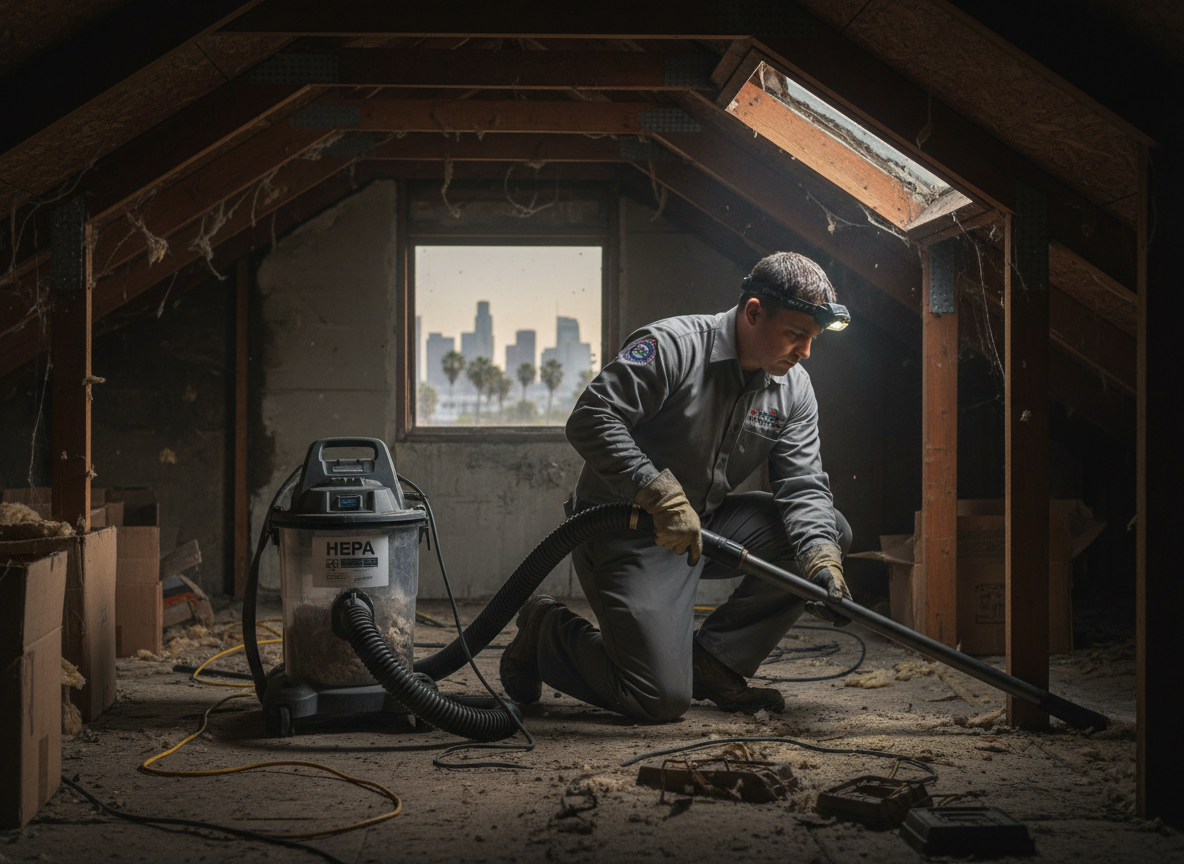
The attic is where the majority of California rodent infestations end up, and roof rats (Rattus rattus) are the reason. Roof rats are arboreal climbers rather than burrowers. They reach the roof via tree limbs, palm frond skirts, ivy runs, fence lines and utility cables, then enter through the openings that almost every roof has: the gap where the roof deck meets the fascia, unscreened gable and soffit vents, tile roof end gaps, uncapped chimneys, and the penetrations around vent stacks and AC line sets. Once inside, they nest in the insulation and travel the rafters and top plates, which is what produces the scratching and scurrying sounds directly overhead at night.
The damage runs well beyond the noise. Rodents gnaw continuously because their incisors grow throughout life, and in an attic the available materials are electrical wiring, HVAC flex duct, plumbing lines and structural timber. Chewed wiring is a documented fire risk and one of the more serious consequences of an untreated attic infestation. Damaged flex duct dumps conditioned air into the attic and pulls contaminated attic air into the living space through the return. Insulation used as nesting material becomes compressed, matted and urine-saturated, losing most of its effective R-value and driving up cooling costs through California's long hot season.
Sound is the usual diagnostic starting point and it is genuinely informative. Rats produce heavier, slower movement, scratching and gnawing, most active in the two to three hours after dusk and again before dawn. Mice produce lighter, faster scurrying and more constant activity. Squirrels, by contrast, are diurnal, so daytime activity overhead with silence at night points to squirrels rather than rodents and changes the treatment approach entirely. The inspection confirms species from droppings, rub marks, runway patterns in the insulation and gnaw damage before any device is placed.
Attic work has an obligatory sequence. Trapping goes first, with snap traps placed on the rafter and top plate runways where rub marks and droppings confirm travel, checked on a set schedule until activity ceases. Exclusion follows only once the attic is clear, because sealing a roofline with rats still inside produces dead rodents in inaccessible voids and weeks of decomposition odor. Decontamination comes last: contaminated insulation vacuum extracted into sealed containment, joists and ceiling deck disinfected, urine residue treated enzymatically to remove the pheromone trails that draw new rodents back, ectoparasites treated, and replacement insulation installed to the appropriate R-value.
The most frequently skipped step is vegetation clearance, and it is the reason attics get reinfested after otherwise competent work. Roof rats do not fly. If a tree limb is still touching the eave, or a palm still carries an uncleared dead frond skirt, or ivy still runs up the wall to the roofline, the access route is intact and only the specific holes have changed. California fruit trees dropping unpicked fruit compound this by supplying the food base. Clearance requirements are specified as part of the job rather than mentioned in passing.
Technician insight
Homeowners consistently underestimate the wiring risk in an attic infestation. Rodent incisors never stop growing, so the animal is not chewing electrical cable out of malice or hunger, it is chewing because it has to wear its teeth down, and romex insulation is a convenient material at head height along a rafter run. That is a documented cause of attic fires, and it is a reason not to sit on an attic rat problem for a season. The second thing is that after a heavy infestation the attic insulation is usually finished. People resist replacing it because of the cost, then wonder why their cooling bill has climbed and why the new rats found the same spot. Nest-matted, urine-saturated insulation has lost its R-value and is still broadcasting a scent trail saying this is a proven nesting site.
Scratching overhead in a two-story home with a tile roof
The homeowner reported scratching directly above the master bedroom ceiling starting shortly after dusk each night, which had been going on for around six weeks. Attic inspection found roof rat droppings concentrated along the top plate above that room, clear rub marks on two rafters, a nest built into the blown-in insulation near the gable end, and gnaw damage to a run of romex and one section of flex duct. The roof survey found the entry: an uncapped gap at a tile roof end course near a valley, plus an unscreened gable vent. A queen palm about eight feet from the eave still carried a full dead frond skirt and was the access route. Trapping ran nine days until two consecutive checks were empty. Both roof openings were then sealed with sheet metal and 1/4 inch hardware cloth and the gable vent screened. Roughly two hundred and twenty square feet of contaminated insulation was extracted, the deck disinfected and enzymatically treated, mites treated, and new insulation blown in to code R-value. The palm skirt was cleared and the damaged romex section replaced by a licensed electrician. No activity since.
Attic Rodent Removal Services We Offer
✓Roof Rat Trapping in Attics
Snap trap placement on rafter and top plate runways confirmed by rub marks and droppings, with scheduled checks and repositioning as activity shifts.
✓Roofline Exclusion
Sealing roof-to-fascia gaps, screening gable and soffit vents with 1/4 inch hardware cloth, closing tile roof end gaps and fitting chimney caps.
✓Contaminated Insulation Removal
Vacuum extraction of urine-saturated and nest-matted insulation into sealed containment, with disinfection of the exposed joists and ceiling deck.
✓Attic Insulation Replacement
Installation of new blown-in or batt insulation to the appropriate R-value for the climate zone, restoring the thermal performance the infestation destroyed.
✓Chewed Wiring and Duct Assessment
Identification and documentation of gnaw damage to electrical wiring, HVAC flex duct and plumbing lines for repair by the appropriate trade.
✓Attic Decontamination and Odor Treatment
Disinfection and enzymatic treatment of urine residue and pheromone trails, plus ectoparasite treatment for fleas and rat mites left in the space.
✓Vegetation and Roof Access Clearance
Specification of required clearance for overhanging limbs, palm frond skirts, ivy runs and utility line access points.
Attic Rodent Removal Cost in California
| Service | Typical Range | What Affects It |
|---|---|---|
| Attic and roofline inspection | $150-$325 | Higher where attic access is restricted or roof pitch limits safe survey |
| Trapping and removal | $300-$750 | Based on infestation level and number of scheduled device checks |
| Roofline exclusion sealing | $500-$1,800 | Driven by entry point count, roof pitch and material type; tile roofs sit higher |
| Contaminated insulation removal | $1.50-$3.50 per sq ft | Vacuum extraction into sealed containment, higher where access is restricted |
| Replacement insulation install | $1.75-$4.00 per sq ft | Varies by material and target R-value for the climate zone |
| Decontamination and ectoparasite treatment | $400-$1,200 | Disinfection, enzymatic urine treatment and flea or mite treatment, priced by area |
Ranges are typical for California and confirmed with an exact written quote before any work starts.
How it works
- 1
Attic Inspection and Species Confirmation
Full attic entry to map runways, droppings, rub marks, nesting sites and gnaw damage, confirming whether the activity is roof rats, mice or squirrels based on evidence and activity timing.
- 2
Roofline Entry Point Survey
Exterior roof level survey identifying every opening: fascia gaps, vents, tile ends, chimney, penetrations, plus the vegetation and utility routes providing access.
- 3
Trapping to Clear the Attic
Snap traps set on confirmed runways, checked on a set schedule and repositioned as needed, until consecutive checks show zero activity.
- 4
Roofline Exclusion Sealing
Only after the attic is confirmed clear, all openings are sealed with 1/4 inch hardware cloth and sheet metal, vents screened and chimney capped.
- 5
Contaminated Insulation Extraction
Pre-misting with disinfectant, then vacuum extraction into sealed containment. Never dry disturbed, because aerosolized droppings are the hantavirus exposure route.
- 6
Decontamination and Restoration
Joists and ceiling deck disinfected, urine residue and pheromone trails treated enzymatically, ectoparasites treated, and replacement insulation installed to target R-value.
Pricing
Attic work is priced by infestation level, roof access difficulty, entry point count and square footage of contaminated insulation. Written quote after inspection, Mon-Fri 8am-6pm and Sat 9am-2pm.