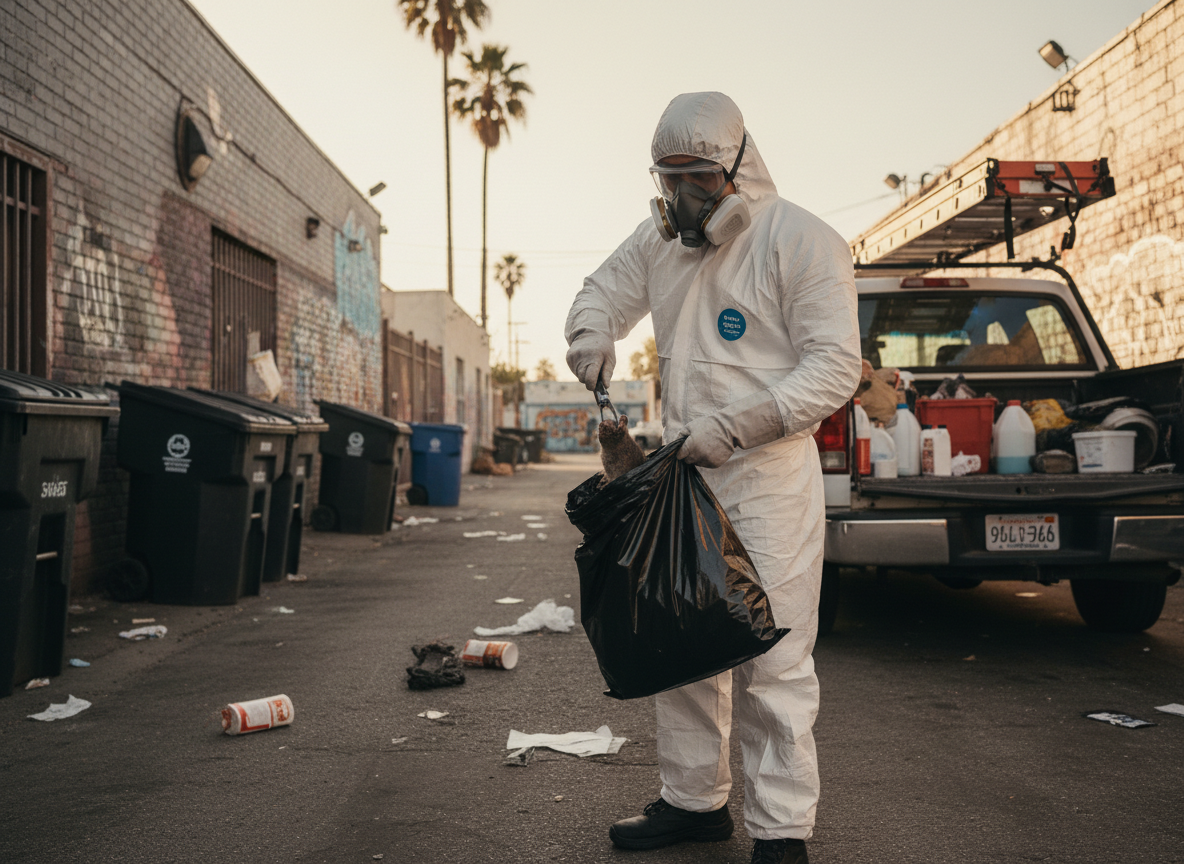
Sacramento's older housing stock around the State Capitol and Old Sacramento often features narrow wall voids and crawl spaces where roof rats die after cool wet winters drive them indoors. Hot dry summers along the American River Parkway and near CA-99 corridors speed decomposition in attics, producing odors that travel through HVAC systems in homes bordering agricultural fields. Crews working off I-5 and US-50 regularly face missed carcasses in basements where seasonal groundwater complicates extraction without damaging older foundations. Common local failure modes include incomplete removal in structures near Sutter's Fort, where rodents enter from the parkway and leave remains in insulation that homeowners cannot reach.
Dead Rodent Removal in Sacramento — What We Handle
- ✓Access in Victorian-era attics and narrow Sacramento county crawl spaces requires specialized tools not needed in newer subdivisions.
- ✓Odor complaints peak after wet winters when decomposed rodents in wall voids near the American River become noticeable during the first heat wave.
- ✓Disposal logistics differ near government buildings and the State Capitol due to stricter local handling rules along I-80 and US-50 routes.
Dead Rodent Removal Services We Offer in Sacramento
✓Wall Void Carcass Location and Extraction
Odor gradient tracing and inspection camera work through minimal access holes, followed by carcass removal and repair of the opening.
✓Attic Dead Rodent Removal
Extraction from insulation and rafter cavities, removal of contaminated insulation, disinfection and screening of the entry point that allowed access.
✓Crawl Space and Subfloor Removal
Carcass recovery from underfloor areas, vapor barrier and insulation assessment, and disinfection of the affected ground area.
✓HVAC and Ductwork Rodent Removal
Extraction from supply and return ducts and plenums, where decomposition odor circulates through the whole building every time the system runs.
✓Odor Treatment and Deodorization
Enzymatic treatment that breaks down decomposition residue at source, plus containment measures where extraction is genuinely not possible.
✓Ectoparasite Treatment
Treatment for fleas, rat mites and other ectoparasites that leave the carcass and migrate into living space one to two weeks after the host dies.
Dead rodent removal starts with locating the carcass, which is usually the hard part. Decomposition odor travels through wall cavities, ductwork and floor systems and surfaces some distance from the actual body. Homeowners commonly search the room where the smell is strongest and find nothing, because the rodent is in a wall void one room over, above a dropped ceiling, inside a soffit, under a bath tub, behind a dishwasher, or in the crawl space directly below. Technicians work backwards from the odor gradient combined with the known runways for the species involved, using inspection cameras through small access holes rather than opening walls at random.
The odor timeline follows a predictable pattern and helps set expectations. A house mouse typically produces noticeable odor for one to two weeks. A roof rat or Norway rat, being much larger, produces strong odor for three to six weeks, sometimes longer in a cool crawl space where desiccation is slow. Odor peaks around days four to ten in warm conditions. Heat accelerates the whole cycle, which is why summer complaints escalate fast in attics that reach well over a hundred degrees. If the carcass is genuinely inaccessible, containment and odor treatment can bridge the gap, but extraction is always the proper fix.
How It Works in Sacramento
- 1
Odor Source Location
Systematic tracing of the odor gradient across rooms, voids and floor levels, combined with known runways for the species. Inspection cameras used through minimal access points before any wall is opened.
- 2
Access and Extraction
The smallest workable access is created, the carcass and any nesting material extracted, and contaminated insulation removed.
- 3
Disinfection
The area is misted with disinfectant before disturbance rather than dry swept, then cleaned. Respiratory protection and gloves used throughout because rodent waste can carry hantavirus and leptospirosis.
- 4
Odor Neutralization
Enzymatic treatment applied to break down decomposition residue at source. Masking agents are not used as a substitute for removal.
- 5
Ectoparasite Treatment
The void and surrounding area treated for fleas and rat mites that leave the carcass once the host dies.
- 6
Entry Point Sealing and Repair
Access opening repaired and the original rodent entry point sealed with 1/4 inch hardware cloth or sheet metal so the situation does not repeat.
Serving All of Sacramento
We regularly handle dead rodent removal jobs near:
- 📍California State Capitol
- 📍Old Sacramento
- 📍Sutter's Fort
- 📍American River Parkway
Dead Rodent Removal Pricing in Sacramento
Cost depends on how accessible the carcass is, how much contaminated material needs removing and whether ductwork is involved. Written quote after inspection, Mon-Fri 8am-6pm and Sat 9am-2pm.
Want the full picture of this service? See our Dead Rodent Removal page, or everything we do in Sacramento, CA.