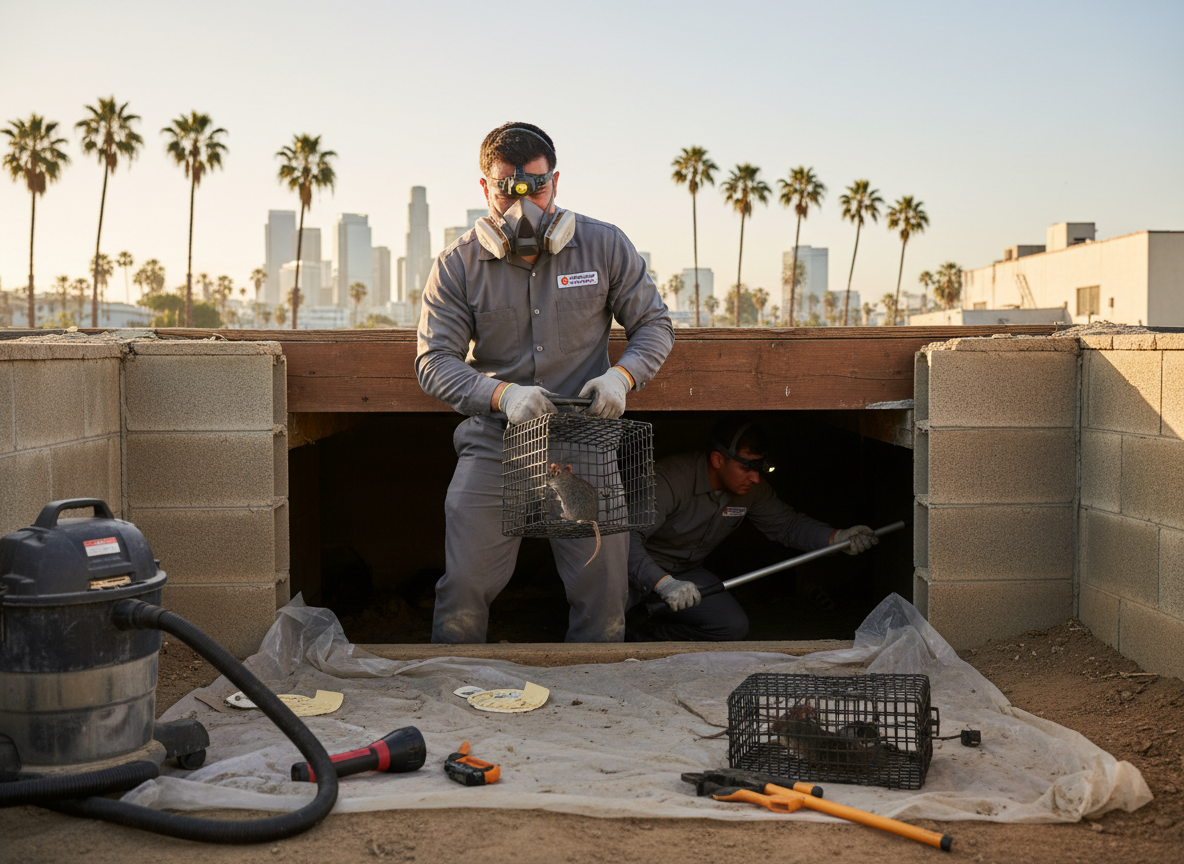
Rodent control in Long Beach comes down to three local facts. The ocean keeps winters mild enough that there is no die-off, so pressure runs all twelve months. A large share of the housing is pre-1950 and sits on raised foundations with vented crawl spaces. And salt air corrodes vent screening far faster than anything inland. Put those together and a building that was properly sealed five years ago is often open again now.
Which rodent you have
Roof rats are the residential default here. They climb, reaching Long Beach roofs from mature street trees, from Mexican fan palms and queen palms carrying uncleared dead frond skirts, from fence lines and from overhead utility drops. Once up there they enter at roof-to-fascia gaps, unscreened gable and soffit vents, and the open end courses of Spanish and barrel tile.
Norway rats are the port-adjacent and older-neighborhood species. They stay at grade, burrow against foundations, and come in through crawl space vents and floor drains.
House mice turn up in kitchens across every ZIP from 90802 to 90815, usually working inward from a garage or crawl space through a gap no wider than a quarter inch.
Getting this wrong is the most common reason a rodent job fails. Roof rats enter high and Norway rats enter low, so treating the wrong half of the building leaves the actual route open.
Signs worth acting on
- Scratching or running overhead after dark, heavier and higher up for rats than for mice
- Droppings along wall bases, on top of ceiling joists, in the garage or behind kitchen appliances
- Greasy rub marks where a rat uses the same rafter or pipe run every night
- Gnaw marks on wiring, plastic pipe or stored boxes
- Insulation that looks flattened, tracked through or pushed into piles
- A musky smell that gets stronger in warm weather
- A dog or cat fixed on one spot of wall or ceiling
Chewed wiring is the one to treat as urgent rather than annoying. It is a documented fire risk, and it is the kind of damage an insurer asks hard questions about.
Where they get in
Anything wider than a quarter inch is passable for a mouse, and half an inch for a rat. In Long Beach the recurring openings are:
- Foundation and crawl space vents with corroded screening, which the salt air accelerates
- Crawl space access panels that have warped and no longer seat flush
- Open end courses on Spanish and barrel tile roofs, which need bird stop closures rather than mortar
- Roof-to-fascia gaps that are invisible from the ground
- Unscreened gable, soffit and exhaust vents
- Gaps at the siding-to-foundation junction and around utility penetrations
- Garage door corners and worn bottom seals
Rooftop solar adds one more. A panel array creates a sheltered, shaded cavity directly above the roof deck, and roof rats nest under it and chew the wiring runs. Long Beach has a lot of residential solar, and a roof inspection that skips under the array is not a complete inspection.
Why the pressure never lets up
Inland California gets a seasonal drop in rodent activity. Long Beach does not. The marine layer and ocean-moderated temperatures keep winter mild enough that breeding continues, so an unsealed building is under pressure year round. That is why trapping on its own buys a few weeks and then the problem returns.
The LA River mouth, the storm channels and the Naples canals also give rodents continuous corridors through the city, and fruit trees dropping unpicked citrus and avocado supply the food base that keeps numbers up.
The health angle, stated accurately
Flea-borne typhus is the one that is genuinely a Long Beach issue rather than a generic pest-control talking point. It is caused by Rickettsia typhi and spread by fleas carried on rats, opossums and free-roaming cats. Because Long Beach runs its own health department, its case numbers are reported separately from the county's. The city recorded 39 cases in 2025, its highest on record, passing the previous record of 28 set in 2021, with around 72 percent of cases hospitalized. The Health Department reported that the summer 2025 outbreak was brought under control and that no further outbreaks had been identified in 2026. For scale, Los Angeles County, whose count excludes Long Beach and Pasadena, logged 220 cases in 2025.
That is the reason to keep rodents out of a structure, and the reason droppings are removed wet rather than swept dry. Rodent waste can also carry hantavirus, leptospirosis and salmonella. None of this justifies panic, and anyone quoting you on fear rather than on what they found in your attic is selling rather than inspecting.
Who handles what
Long Beach is one of the few California cities that runs its own health department rather than falling under the county. The Long Beach Department of Health and Human Services, Bureau of Environmental Health, operates a Vector Control Program, reachable on (562) 570-4132. Areas east of Lakewood Boulevard are covered by the Greater Los Angeles County Vector Control District instead, and a small section in the northwest by the Compton Creek Mosquito Abatement District.
What that program covers is public property: shorelines, harbors and parks. Private homes and businesses are the owner's responsibility, which is where structural rodent work comes in.
How a job runs
- Inspection and species identification. Roof, attic, crawl space, garage and exterior perimeter. Every entry point is mapped and photographed, so you see what we saw rather than taking it on trust.
- Trapping. Snap traps set flush on confirmed runways where rub marks and droppings show travel. Rats avoid unfamiliar objects placed in open space for several days, which is why placement matters far more than trap count.
- Exclusion. Once consecutive checks show no activity, openings are closed with quarter inch hardware cloth, sheet metal and copper mesh. Sealing before the building is clear would trap rodents inside the wall system.
- Decontamination. Droppings and contaminated insulation are pre-misted with disinfectant and removed wet. Contaminated insulation also holds scent trails that pull the next rodent back to the same spot.
- Verification. A return visit confirms zero activity and checks every seal before the job closes.
Most single family homes take two to four visits across two to three weeks. Trapping alone usually clears a structure in 7 to 14 days. Heavy attic infestations and commercial sites take longer.
What moves the price
The inspection and the written quote are free. After that the number is driven by which species you have, how many entry points the inspection finds, whether the work sits on a tile roof or in a crawl space, the age and foundation type of the building, how much contaminated insulation needs replacing, and how many follow-up visits the job takes. Pre-1950 raised-foundation homes and tile roofs sit at the higher end, because both take considerably more labor than a post-war slab house with a composition roof.
Nobody can give you a real figure over the phone. A flat price quoted before anyone has put a ladder against the roof is a guess.
Bait is not the plan
California has closed off most rodent poison. AB 1788 placed a moratorium on second generation anticoagulant rodenticides in 2020. AB 1322 added diphacinone at the start of 2024. AB 2552, signed on September 25, 2024, added chlorophacinone and warfarin, with penalties reaching $25,000 per day for each violation.
Separately from the law, bait creates work. A poisoned rat dies inside a wall void, which in cool coastal conditions means three to six weeks of odor, a flush of fleas and mites leaving the carcass in search of a new host, and a second job to locate and extract it. Trapping recovers the animal.
Keeping them out
- Cut street tree limbs and fence line vegetation back off the roof
- Have palms cleared of dead frond skirts, which are a nesting site and not merely a route
- Pick up fallen citrus and avocado
- Bring pet food and bowls in overnight, and keep bins closed
- Check foundation and crawl space vent screening once a year, because coastal air corrodes it faster than most people expect
- Keep flea control on pets year round, which is the city Health Department's own first piece of typhus advice
- Stop putting bait out
None of this clears an active infestation. It is what stops the next one.
When to call, and what to do first
One mouse in a garage is one mouse. Call when you are hearing activity night after night, when droppings keep reappearing after you clean them up, when there are gnaw marks on wiring, when your own traps keep catching week after week, or when the property is a rental, a restaurant or any food handling business.
Before anyone arrives, three things genuinely help. Stop any bait already out. Note where and when you hear the activity, because timing and location narrow the search before an attic hatch is ever opened. And leave the droppings where they are rather than sweeping them dry.
Rodent Control Services in Long Beach, CA
Residential Rodent Control in Long Beach
Residential rodent control in Long Beach splits along the age and foundation type of the house. Pre-1950 raised-foundati…
Details →Commercial Rodent Control in Long Beach
Commercial rodent control in Long Beach is a documented Integrated Pest Management program rather than a treatment. Beca…
Details →Dead Rodent Removal in Long Beach
Dead rodent removal starts with locating the carcass, which is the hard part. Decomposition odor travels through wall ca…
Details →Rodent Exterminator in Long Beach
A rodent exterminator working on a Long Beach structure needs a California Structural Pest Control Board license, Branch…
Details →Around Long Beach
We regularly work near:
- 📍Port of Long Beach
- 📍Naples Canals
- 📍Belmont Shore
- 📍El Dorado Regional Park
- 📍Queen Mary
- 📍Cal State Long Beach
Rodent Control in Long Beach — Local Notes
- •Long Beach runs its own health department and reports typhus separately from the county. The city recorded 39 flea-borne typhus cases in 2025, its highest on record, passing the previous record of 28 set in 2021. Rats are a primary host for the fleas that carry it, which makes exclusion a public health measure here and not only a property one.
- •Pre-1950 raised-foundation housing in Naples, Belmont Shore, Rose Park and California Heights has vented crawl spaces where screening corrodes quickly in coastal air, making foundation vents the recurring Norway rat entry point.
- •Spanish and barrel tile roofs across much of the city leave open end gaps at the eave and ridge courses. Without bird stop closures these give roof rats direct access under the tile field and onward into the attic.
- •Rooftop solar arrays create a sheltered cavity above the roof deck that roof rats use for nesting, and the wiring runs up there get chewed. Any roof inspection here needs to look under the panels.
- •The Long Beach DHHS Vector Control Program handles public property only, including shorelines, harbors and parks. Private residential and commercial structures are the property owner's responsibility.
- •Ocean-moderated temperatures mean there is no seasonal die-off, so rodent pressure runs year round rather than peaking and collapsing the way it does inland.
Nearby cities we serve